Close Banner
Section Free  - Video Lectures

08. Important Considerations for Switching to Clozapine

Published on March 1, 2022 Expired on April 1, 2025

Brian Miller, M.D., Ph.D., M.P.H.

Professor - Augusta University

Key Points

  • A trial of clozapine should be considered in all patients with treatment-resistant psychosis.
  • Slow titration of clozapine and gradual tapering of the pre-clozapine antipsychotic is strongly advised.

Free Downloads for Offline Access

  • Free Download Presentation File (PPTX)
  • Free Download Audio File (MP3)
  • Free Download Video (MP4)

Slides and Transcript

Slide 1 of 24

And so now, we’re going to talk about important considerations when switching to clozapine.

Slide 2 of 24

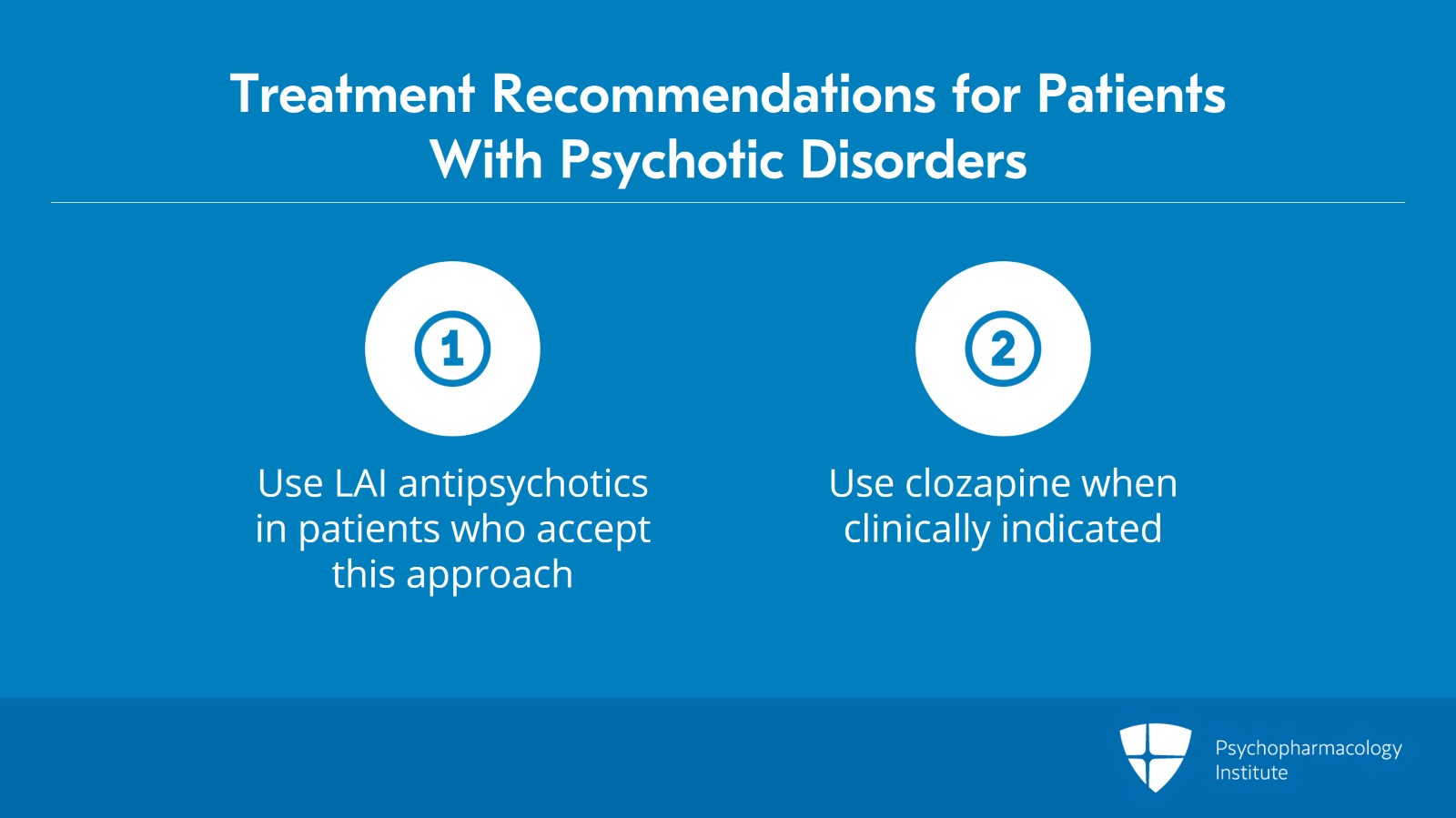
I will readily admit that my two biases, if you will, in the treatment of patients with psychotic disorders, number one, would be to use long-acting injectable antipsychotics liberally in patients who will accept this approach to treatment and, secondly, to use lots of clozapine when clinically indicated.
Free Files
Success!
Check your inbox, we sent you all the materials there.
Slide 3 of 24

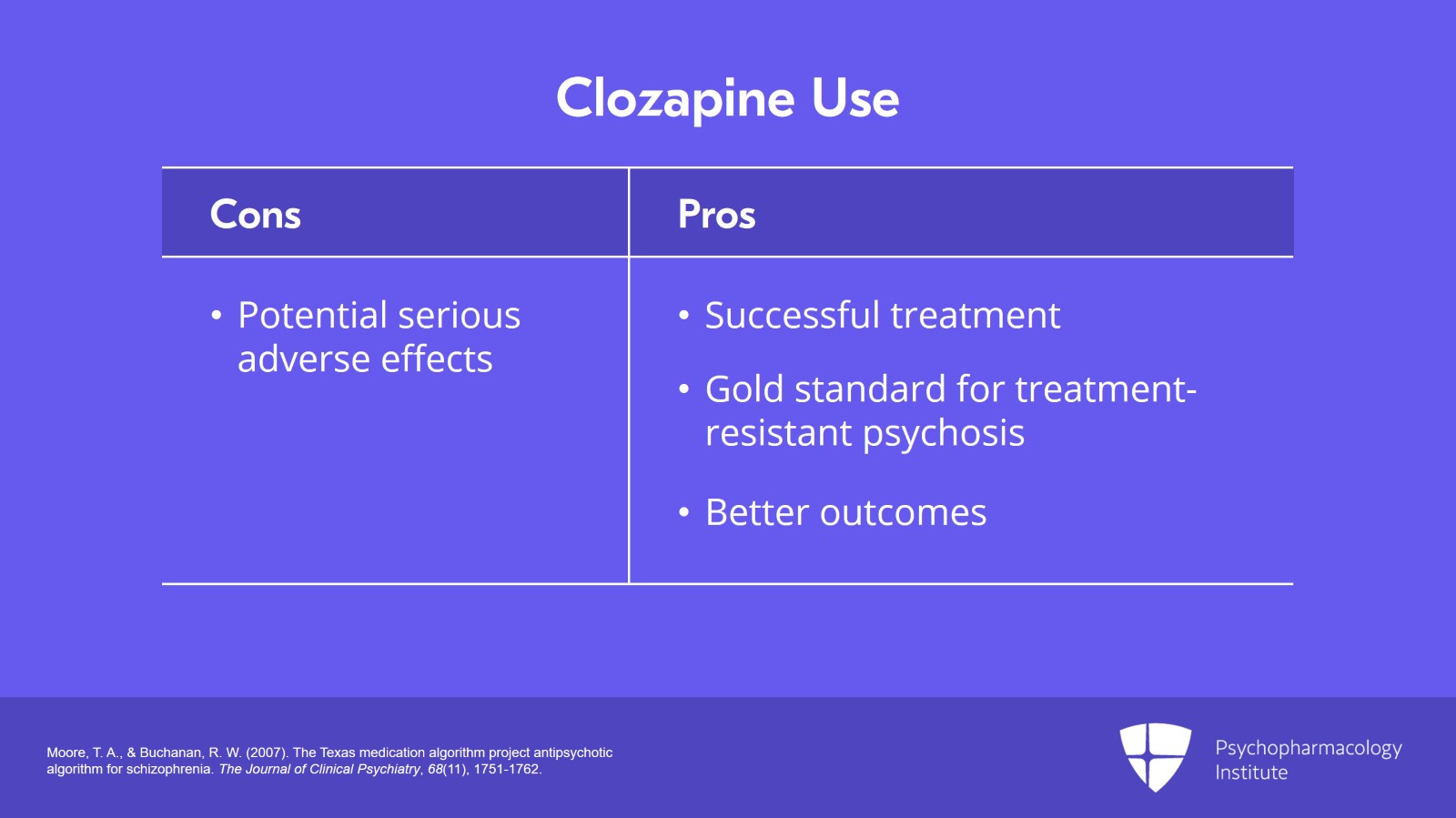
Unfortunately, clozapine is dramatically underutilized. It has a number of potential serious adverse effects. There are a lot of hoops to jump through with clozapine but I have seen tremendous success stories in patients who are treated with clozapine. It is our gold standard treatment for patients with treatment-resistant psychosis and to the extent that we can use it I believe that we will see better outcomes for our patients. So just as kind of my underlying perspective, I treat a lot of patients with clozapine and I offer clozapine to anyone who, you know, would meet those criteria. So that kind of segues to when do we use clozapine.
References:
  • Moore, T. A., & Buchanan, R. W. (2007). The Texas medication algorithm project antipsychotic algorithm for schizophrenia. The Journal of Clinical Psychiatry, 68(11), 1751-1762.

Slide 4 of 24

Well, I think there’s kind of broad consensus between some different algorithms and expert consensus guidelines. So for example, the Texas Medication Algorithm Project or TMAP for antipsychotics, step one would be a trial of a single second-generation antipsychotic. If the patient has a partial or nonresponse then they should be tried on a different antipsychotic. And if they have a partial or nonresponse to an adequate dose/duration trial of a second antipsychotic, step three is really clozapine.
References:
  • Moore, T. A., & Buchanan, R. W. (2007). The Texas medication algorithm project antipsychotic algorithm for schizophrenia. The Journal of Clinical Psychiatry, 68(11), 1751-1762.
Free Files
Success!
Check your inbox, we sent you all the materials there.

Slide 5 of 24

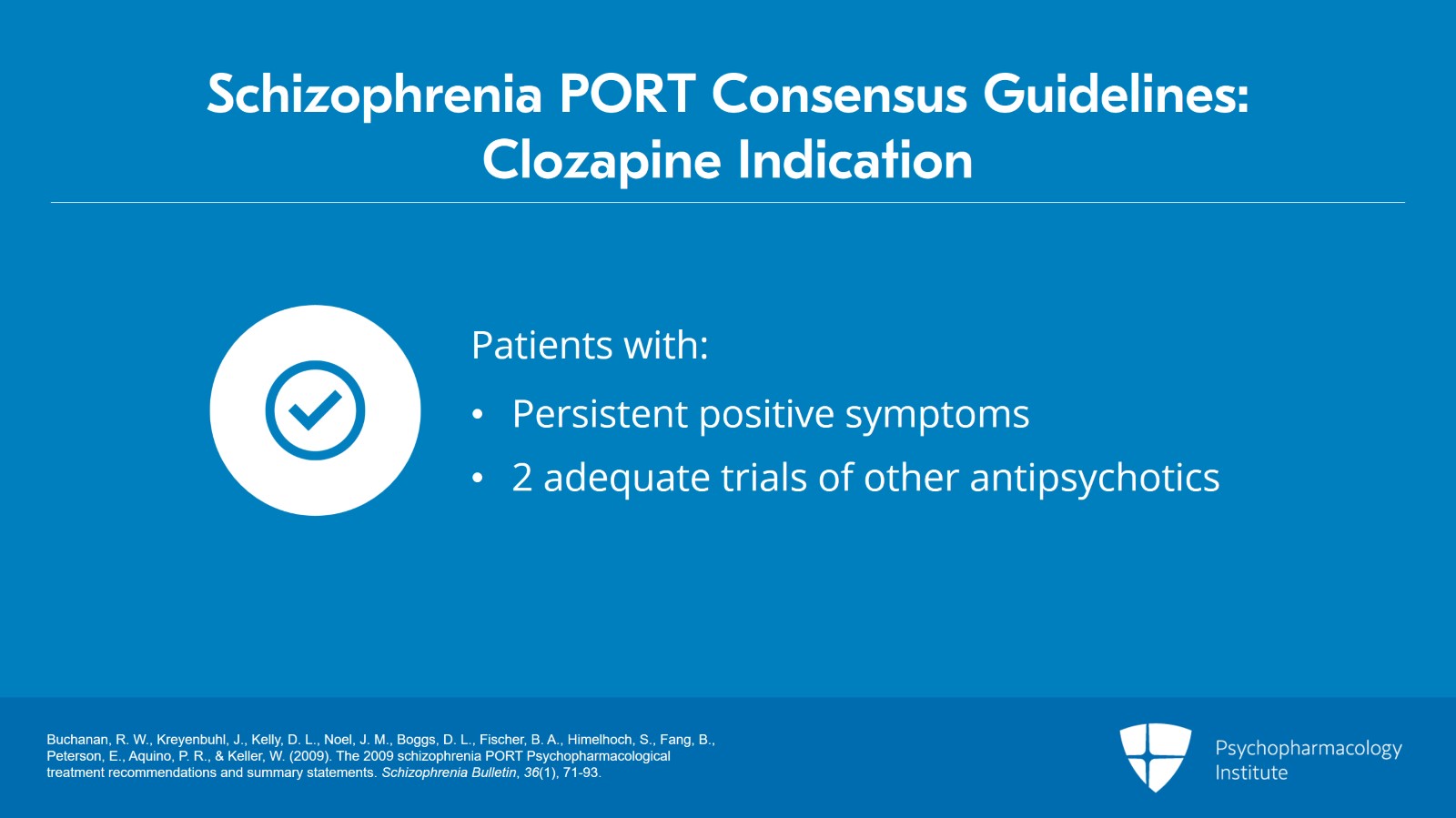
So similar to the TMAP for antipsychotics, the Schizophrenia PORT, Patient Outcomes Research Team, expert consensus guidelines suggest that clozapine should be offered to patients with schizophrenia who experience persistent and clinically significant positive symptoms again after just two adequate trials of other antipsychotic agents.
References:
  • Buchanan, R. W., Kreyenbuhl, J., Kelly, D. L., Noel, J. M., Boggs, D. L., Fischer, B. A., Himelhoch, S., Fang, B., Peterson, E., Aquino, P. R., & Keller, W. (2009). The 2009 schizophrenia PORT Psychopharmacological treatment recommendations and summary statements. Schizophrenia Bulletin, 36(1), 71-93.

Slide 6 of 24

And this really flies in the face of what we encounter clinically and that is I’ll take a patient history and I’ll ask what antipsychotics have been tried in the past. And it’s not uncommon for patients to name five or seven different antipsychotics that have been tried with relative success or lack of success. And I’ll ask, have you ever heard of clozapine or have you been tried on clozapine? And it’s very clear that clozapine has not been discussed despite the fact that they may have failed up to five to seven different antipsychotics.
References:
  • Moore, T. A., & Buchanan, R. W. (2007). The Texas medication algorithm project antipsychotic algorithm for schizophrenia. The Journal of Clinical Psychiatry, 68(11), 1751-1762.
Free Files
Success!
Check your inbox, we sent you all the materials there.
Slide 7 of 24

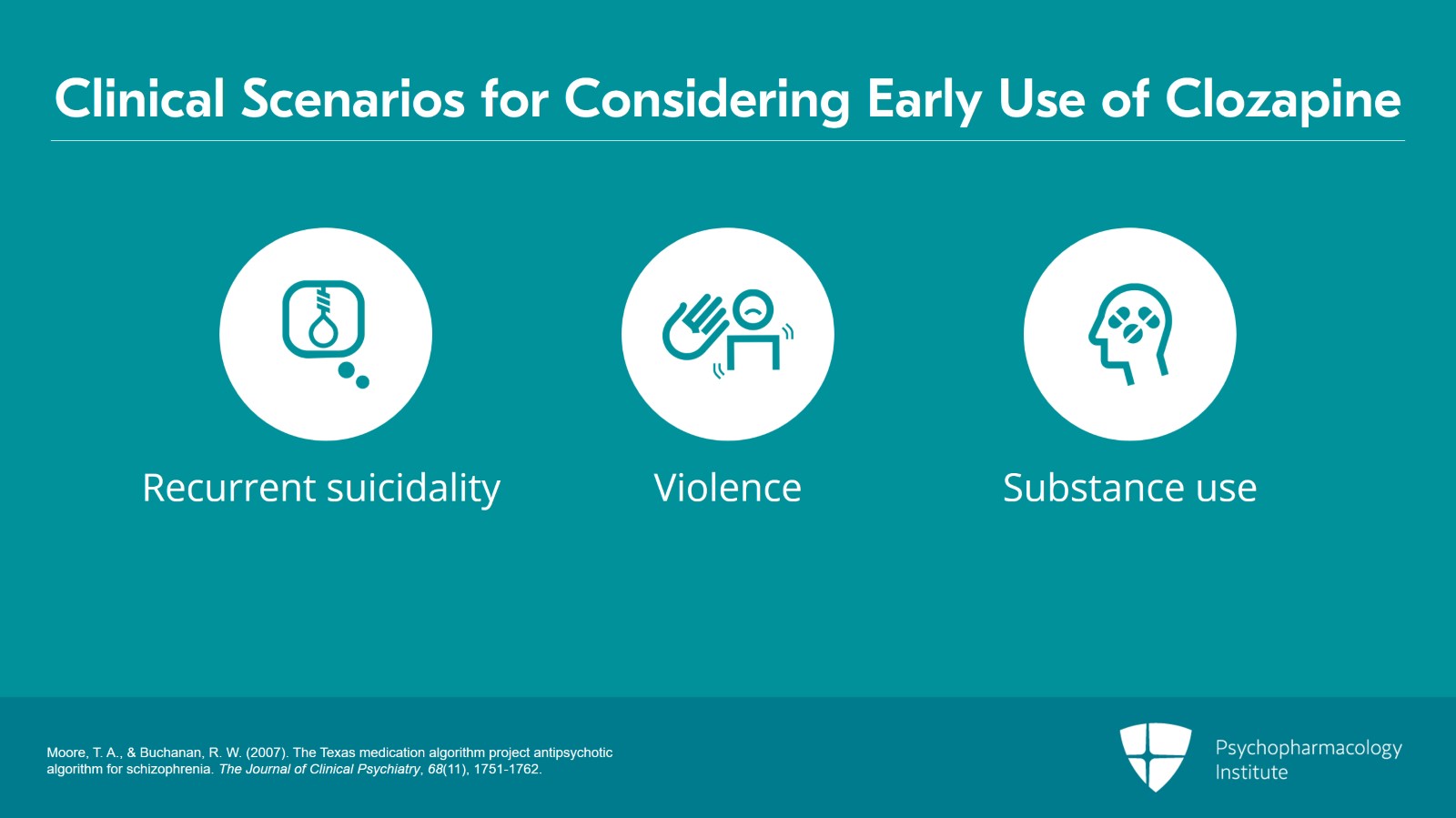
It would be important to consider even earlier in this algorithm a trial of clozapine in patients with a history of recurrent suicidality, violence, or substance use comorbidity which is always a remarkable thing because we think given the need for blood monitoring with clozapine these might be some of the patients who would be, you know, least likely to be able to adhere to the monitoring guidelines yet these are probably the subset of patients who need clozapine the most as there’s tremendous efficacy for clozapine in patients with violence and substance use comorbidity.
References:
  • Moore, T. A., & Buchanan, R. W. (2007). The Texas medication algorithm project antipsychotic algorithm for schizophrenia. The Journal of Clinical Psychiatry, 68(11), 1751-1762.

Slide 8 of 24

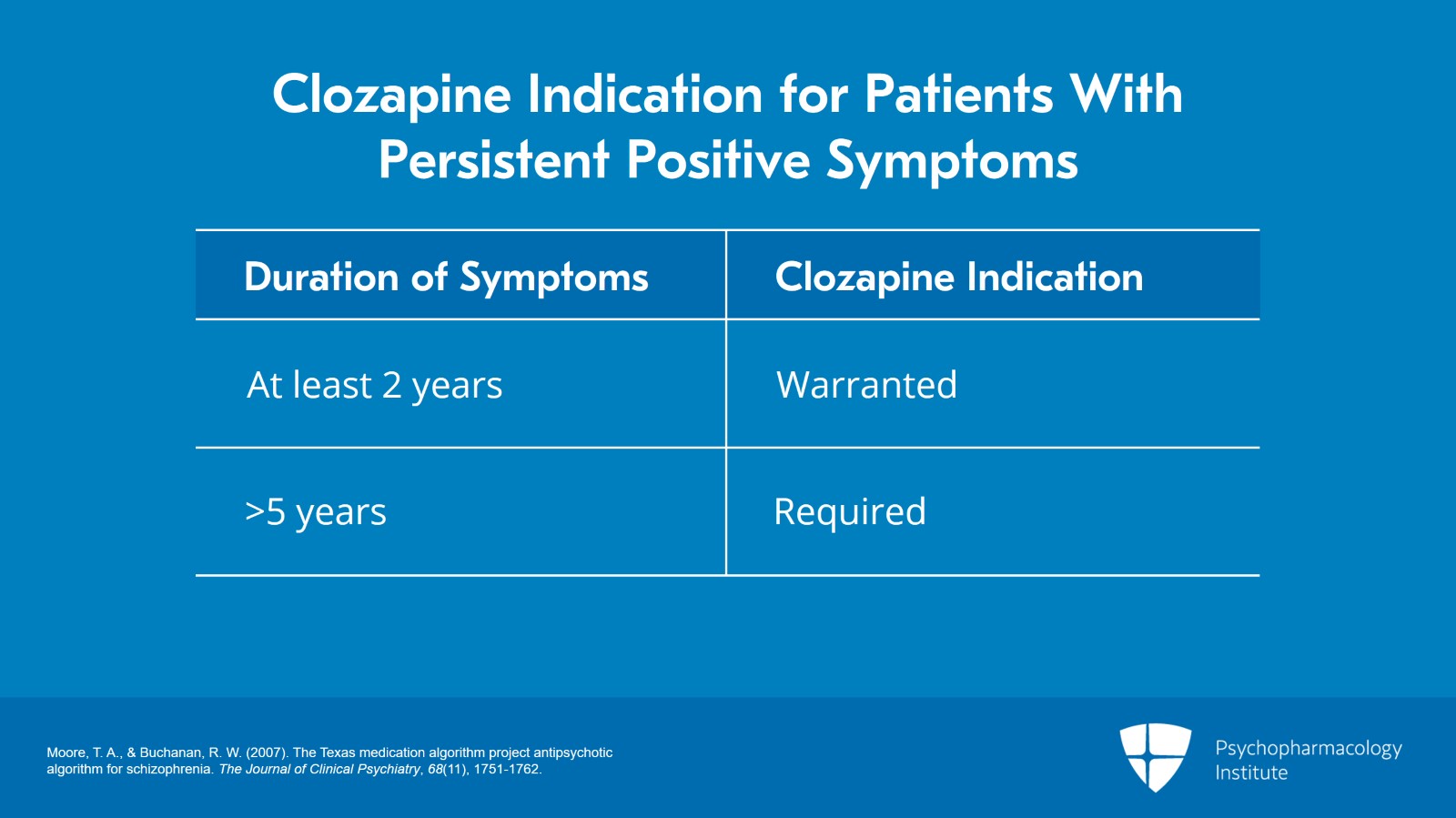
But importantly, patients with persistent positive symptoms for at least two years warrant and more than five years require a clozapine trial. I mean, let that sink in. It’s really, in some ways, arguably malpractice to not offer clozapine to these patients with severe recurrent positive psychopathology.
References:
  • Moore, T. A., & Buchanan, R. W. (2007). The Texas medication algorithm project antipsychotic algorithm for schizophrenia. The Journal of Clinical Psychiatry, 68(11), 1751-1762.
Free Files
Success!
Check your inbox, we sent you all the materials there.

Slide 9 of 24

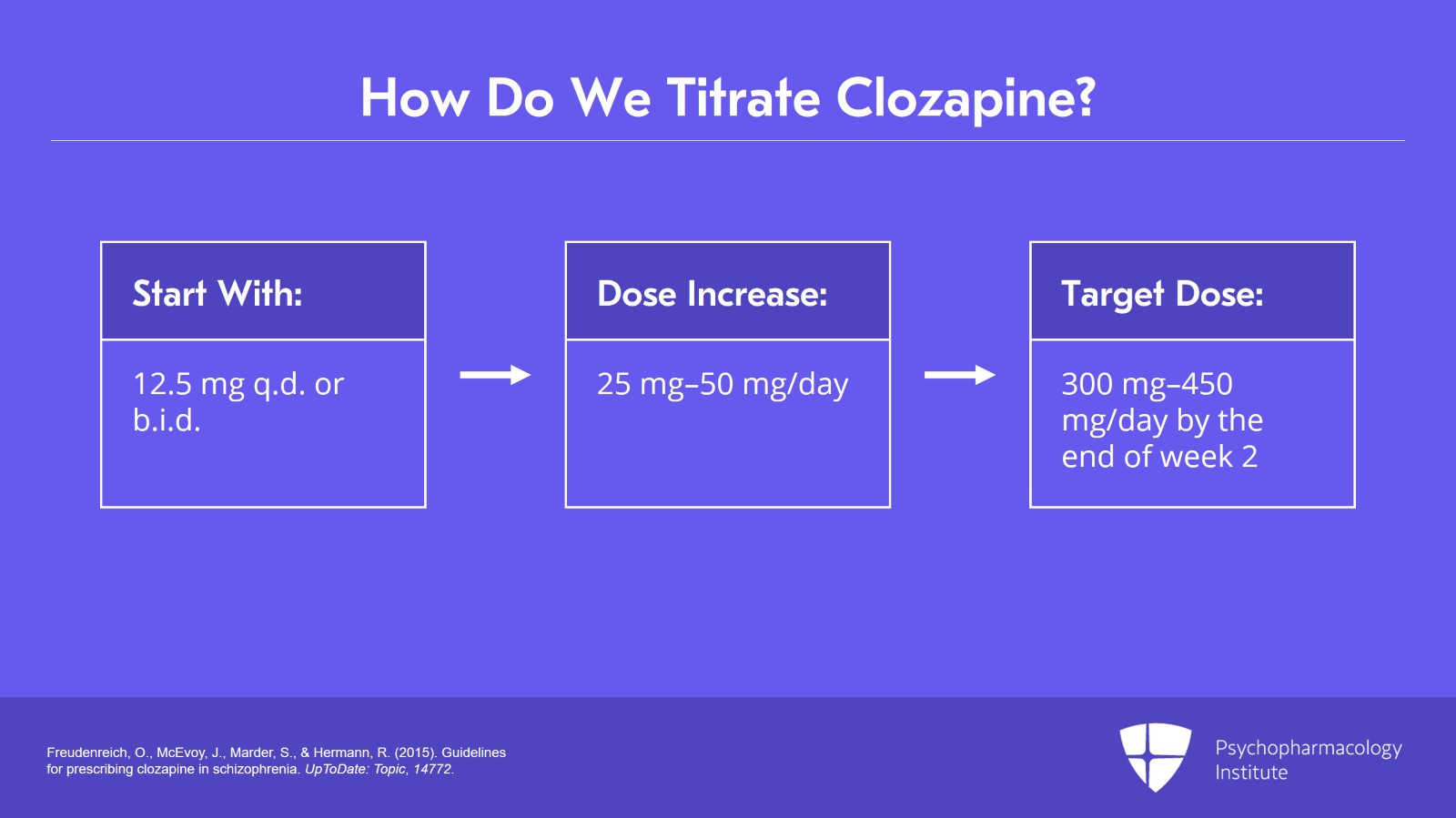
So how do we titrate clozapine? Manufacturer guidelines would say that we would start with 12.5 mg once or twice daily. In my own clinical experience, I think it’s fine to start a total of 25 mg of clozapine on day one divided over two doses. That dose can be increased then by 25 mg to 50 mg daily if well tolerated to a target dose of 300 to 450 mg of clozapine by the end of week two.
References:
  • Freudenreich, O., McEvoy, J., Marder, S., & Hermann, R. (2015). Guidelines for prescribing clozapine in schizophrenia. UpToDate: Topic, 14772.

Slide 10 of 24

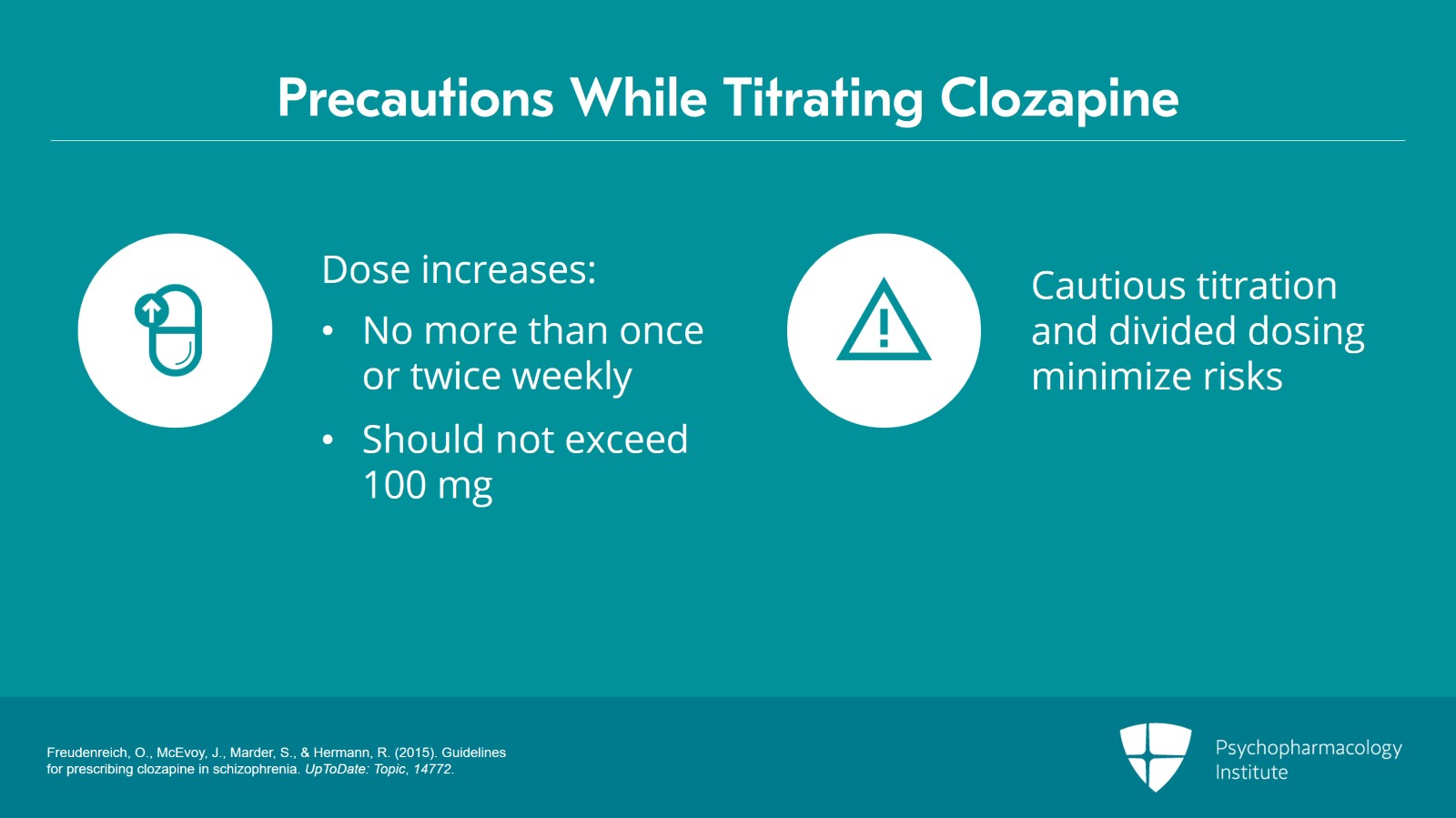
Subsequent dose changes should be made no more than once or twice weekly in increments not exceeding 100 mg. And of course, cautious titration and divided dosing are necessary to minimize risks of hypertension, seizure, and sedation.
References:
  • Freudenreich, O., McEvoy, J., Marder, S., & Hermann, R. (2015). Guidelines for prescribing clozapine in schizophrenia. UpToDate: Topic, 14772.
Free Files
Success!
Check your inbox, we sent you all the materials there.
Slide 11 of 24

My own experience and kind of common approach with clozapine really depends on whether the patient is hospitalized inpatient or outpatient. So, if the patient is an inpatient, I tend to start a total of 25 mg on day one, go up by 25 mg daily as tolerated up to a dose of 100 mg daily. From there, I will go up by 50 mg a day, again to that target dose of 300 to 450 by the end of week two. And I agree with, you know, with kind of expert consensus recommendations not to make dose increases that exceed 100 mg. I would say it’s much more common for me to make increases in intervals of 50 mg.
References:
  • Freudenreich, O., McEvoy, J., Marder, S., & Hermann, R. (2015). Guidelines for prescribing clozapine in schizophrenia. UpToDate: Topic, 14772.

Slide 12 of 24

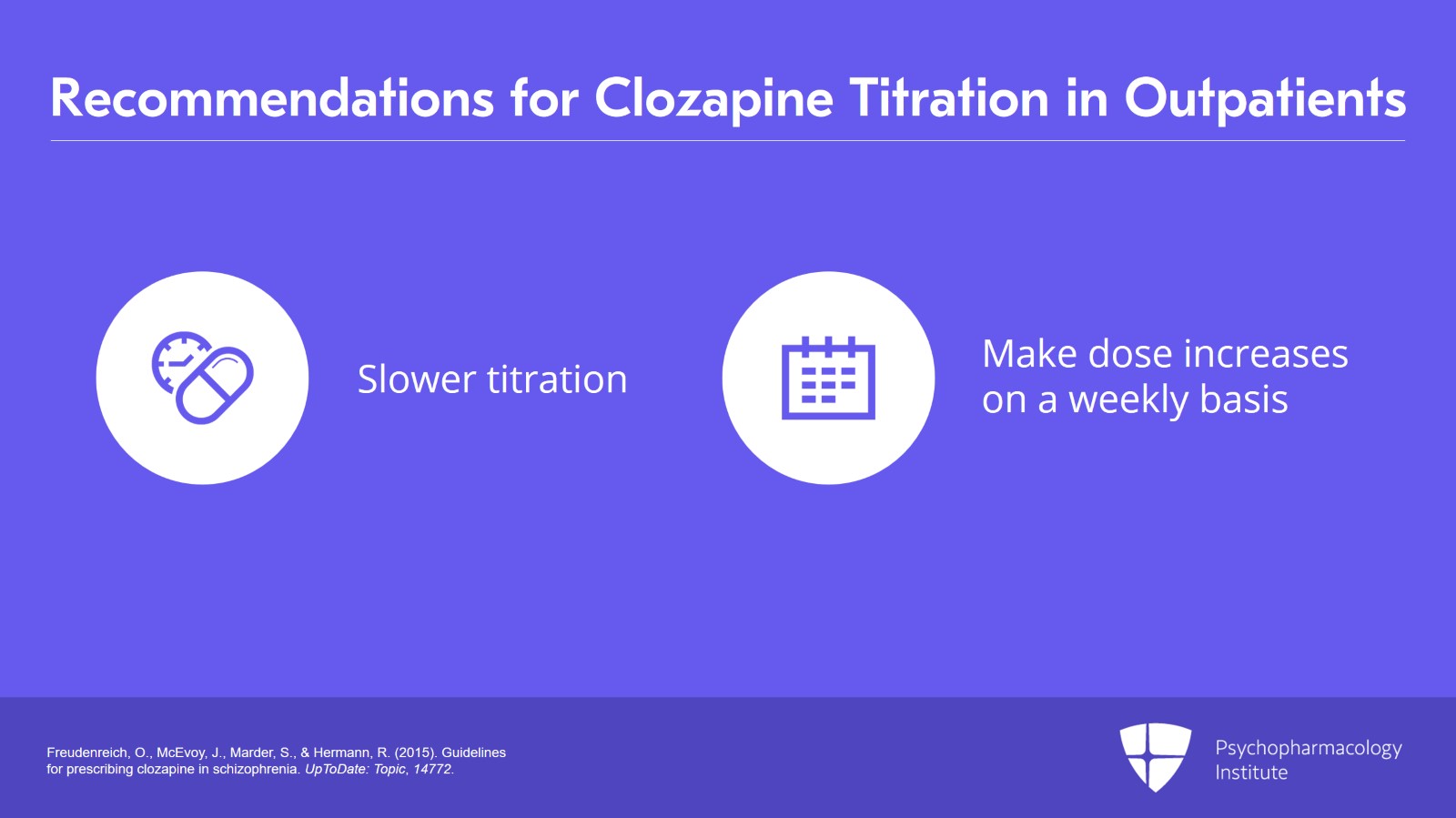
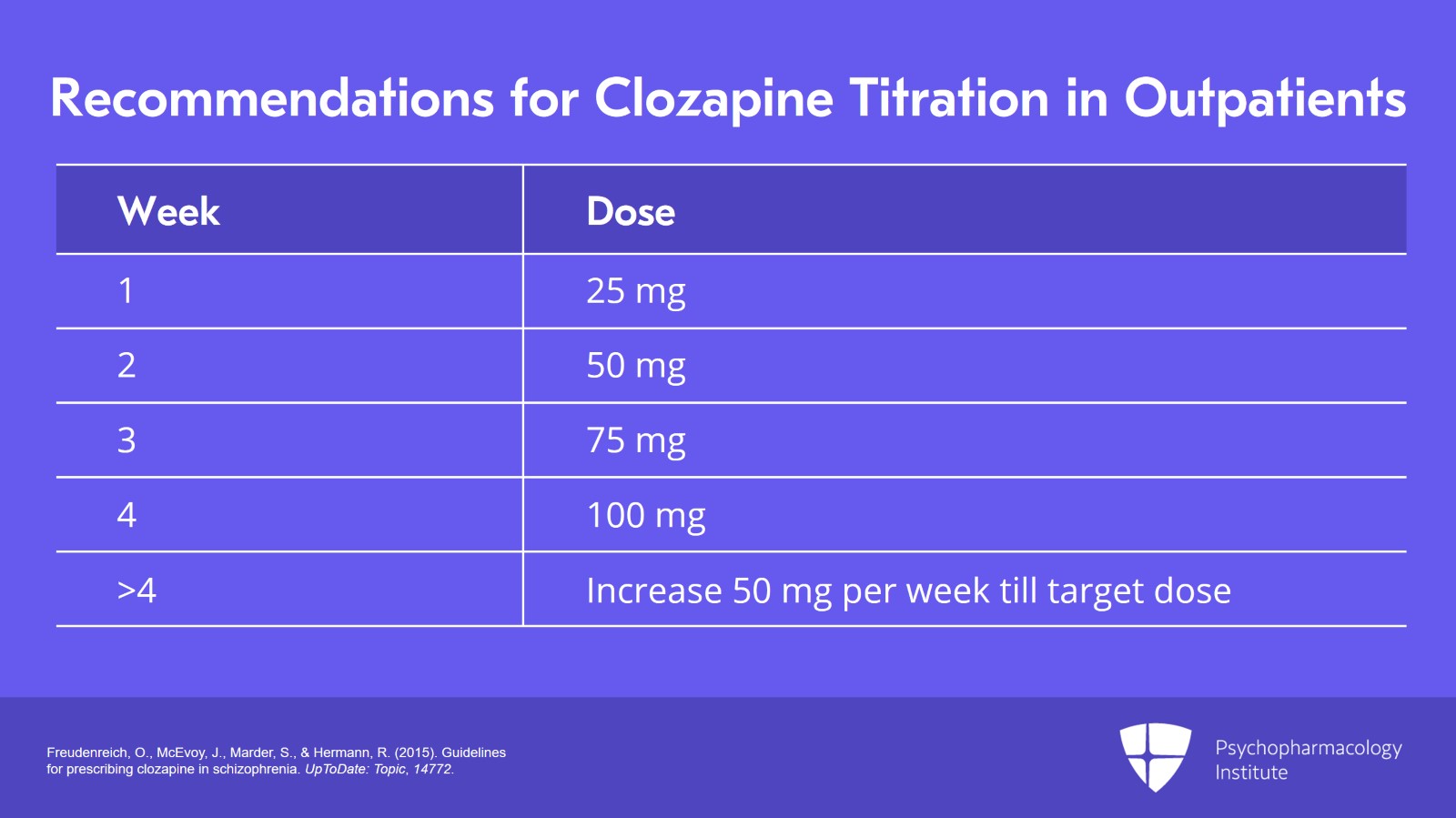
Now, on an outpatient basis, if the patient warrants a clozapine trial but we’re managing them outpatient and they don’t require inpatient hospitalization, I would say that my titration is a little bit slower. It can be confusing for many patients and families to try to change or increase the dose every day while at home. So my own clinical experience, I found it’s a little easier just to make dose increases on a weekly basis with each new prescription.
References:
  • Freudenreich, O., McEvoy, J., Marder, S., & Hermann, R. (2015). Guidelines for prescribing clozapine in schizophrenia. UpToDate: Topic, 14772.
Free Files
Success!
Check your inbox, we sent you all the materials there.
Slide 13 of 24

So it might be 25 mg on week one, 50 mg on week two, 75 on week three up to 100 mg on week four and then from there I would increase by 50 mg per week to that target dose.
References:
  • Freudenreich, O., McEvoy, J., Marder, S., & Hermann, R. (2015). Guidelines for prescribing clozapine in schizophrenia. UpToDate: Topic, 14772.

Slide 14 of 24

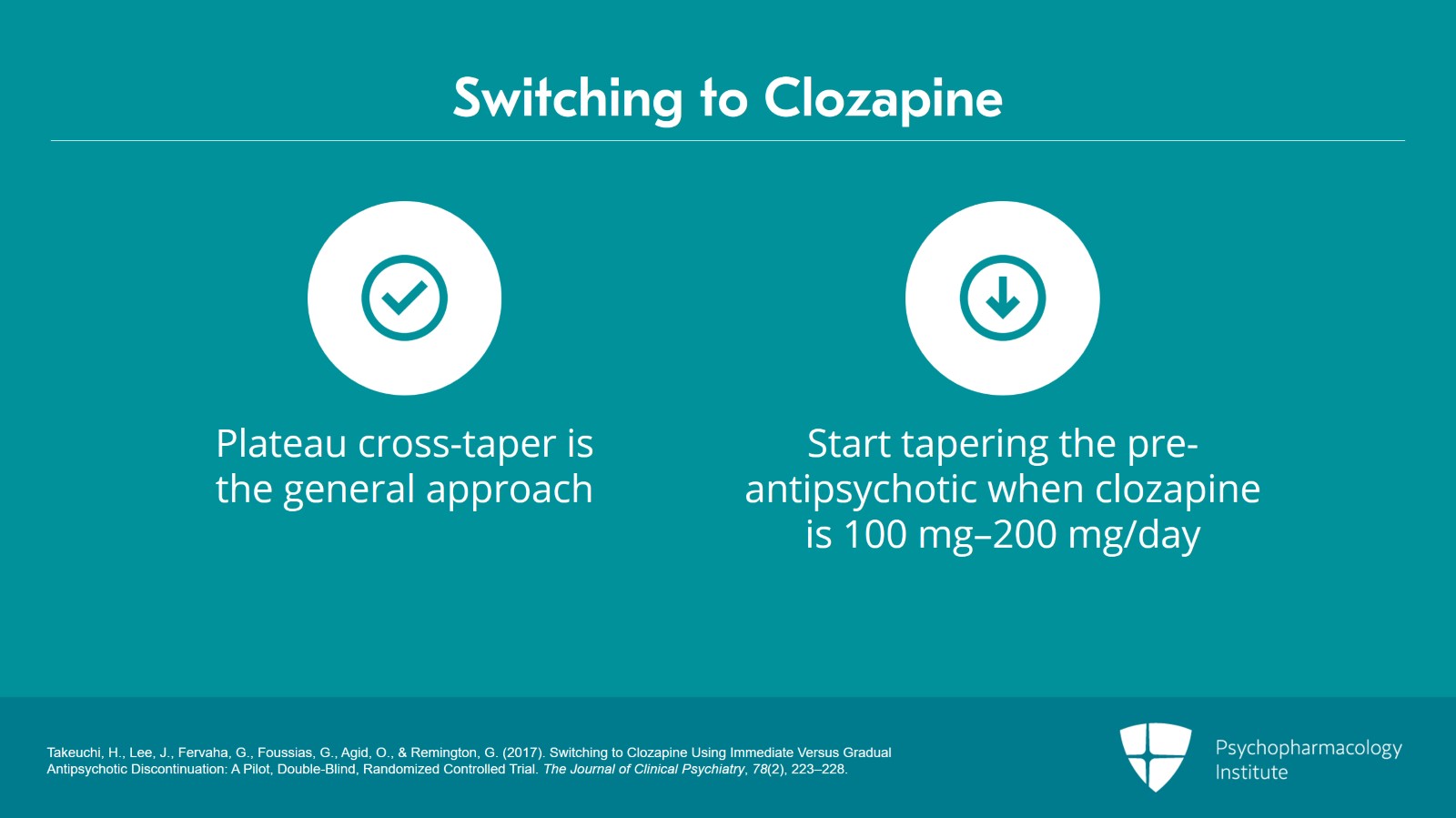
So what do we do with the pre-switch antipsychotic when we’re switching to clozapine? So you may remember that I mentioned this plateau cross-taper switch and that’s kind of the general approach that we take when switching to clozapine. It’s common to start tapering the pre-clozapine antipsychotic once you get to a clozapine dose of 100 mg to 200 mg daily. I usually feel pretty comfortable tapering the pre-switch antipsychotic when I get to a clozapine dose of 100 to 150. So it’s not uncommon that when I make that next increase from 100 mg to 150 mg that that’s when I start to taper off the pre-clozapine antipsychotic.
References:
  • Takeuchi, H., Lee, J., Fervaha, G., Foussias, G., Agid, O., & Remington, G. (2017). Switching to Clozapine Using Immediate Versus Gradual Antipsychotic Discontinuation: A Pilot, Double-Blind, Randomized Controlled Trial. The Journal of Clinical Psychiatry, 78(2), 223–228.
Free Files
Success!
Check your inbox, we sent you all the materials there.
Slide 15 of 24

And I would say that you can reduce the dose of the pre-switch antipsychotic really based on the patient’s clinical response. So if the patient has persistent positive psychopathology and by the end of one to two weeks they’ve had dramatic improvements with a low dose of clozapine, then we can likely attribute that clinical improvement to the effects of clozapine. And so we can fairly quickly get them off of the pre-clozapine antipsychotic because the evidence would say that they really weren’t responding to that agent.  
References:
  • Takeuchi, H., Lee, J., Fervaha, G., Foussias, G., Agid, O., & Remington, G. (2017). Switching to Clozapine Using Immediate Versus Gradual Antipsychotic Discontinuation: A Pilot, Double-Blind, Randomized Controlled Trial. The Journal of Clinical Psychiatry, 78(2), 223–228.

Slide 16 of 24

So one approach would be to reduce the dose of the pre-switch antipsychotic by one quarter once or twice weekly, and again, with the speed of tapering being influenced by clinical settings.
References:
  • Takeuchi, H., Lee, J., Fervaha, G., Foussias, G., Agid, O., & Remington, G. (2017). Switching to Clozapine Using Immediate Versus Gradual Antipsychotic Discontinuation: A Pilot, Double-Blind, Randomized Controlled Trial. The Journal of Clinical Psychiatry, 78(2), 223–228.
Free Files
Success!
Check your inbox, we sent you all the materials there.
Slide 17 of 24

So, as an inpatient, I think you could reduce the dose by a quarter twice weekly, whereas with outpatients it’s probably easier just to make those dose reductions each week especially if you’re seeing the patient in clinic weekly during the the initial period with clozapine.
References:
  • Takeuchi, H., Lee, J., Fervaha, G., Foussias, G., Agid, O., & Remington, G. (2017). Switching to Clozapine Using Immediate Versus Gradual Antipsychotic Discontinuation: A Pilot, Double-Blind, Randomized Controlled Trial. The Journal of Clinical Psychiatry, 78(2), 223–228.

Slide 18 of 24

So there’s really not much evidence in the literature to when and how do you discontinue the pre-clozapine antipsychotic. That said if there’s an urgent need due to some serious adverse effect, then the pre-clozapine antipsychotic should, of course, be stopped immediately.
References:
  • Takeuchi, H., Lee, J., Fervaha, G., Foussias, G., Agid, O., & Remington, G. (2017). Switching to Clozapine Using Immediate Versus Gradual Antipsychotic Discontinuation: A Pilot, Double-Blind, Randomized Controlled Trial. The Journal of Clinical Psychiatry, 78(2), 223–228.
Free Files
Success!
Check your inbox, we sent you all the materials there.

Slide 19 of 24

So, a vignette here about how this might play out in clinical practice. So, Ms. M is a 30-year-old Caucasian female with a history of treatment-resistant schizoaffective disorder. She’s failed three previous antipsychotic trials, two atypicals, and one typical antipsychotic, both at an adequate dose and duration.

Slide 20 of 24

While hospitalized for acute psychosis due to poor therapeutic response, she consented for a trial of clozapine. 20
Free Files
Success!
Check your inbox, we sent you all the materials there.
Slide 21 of 24

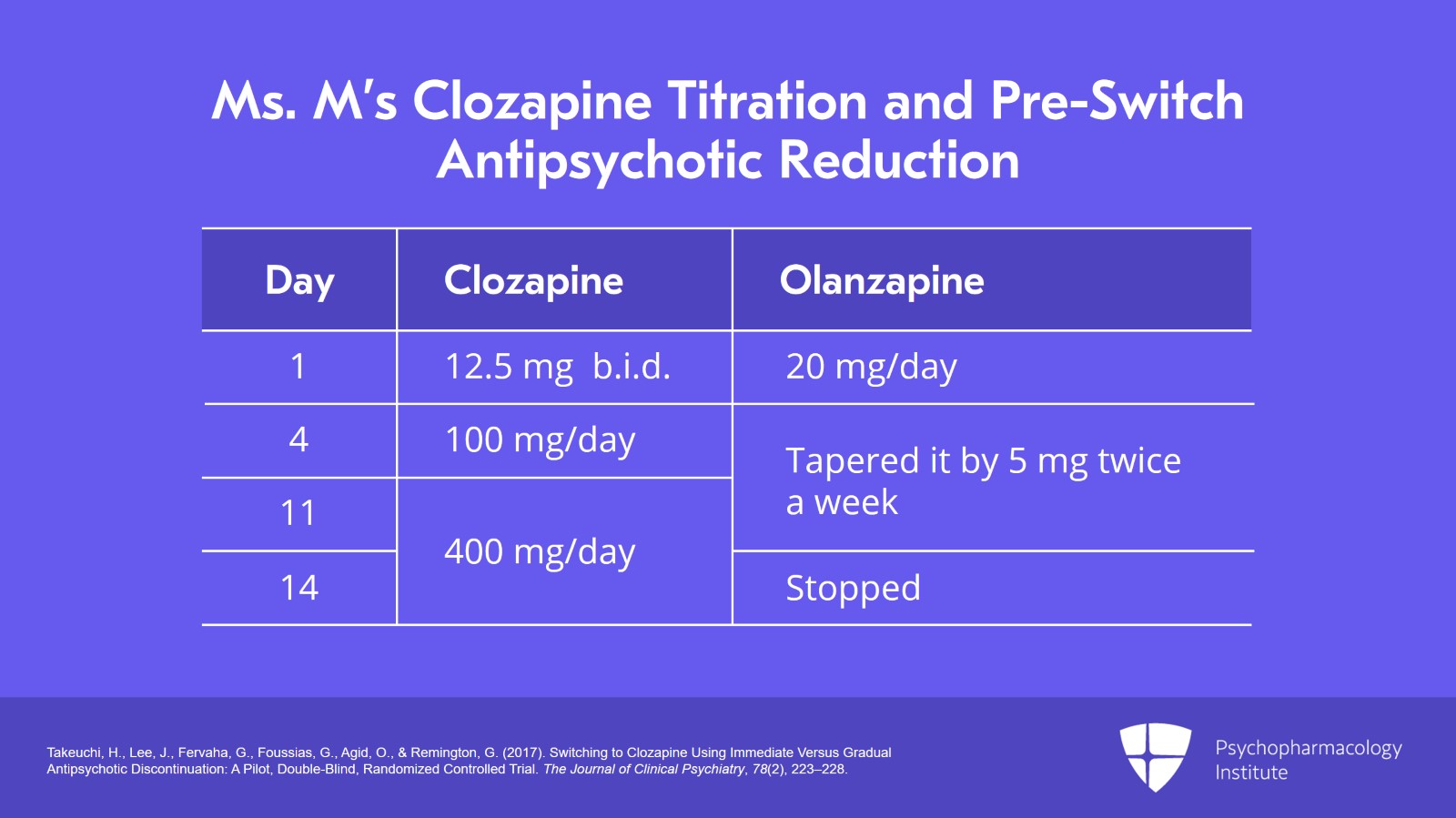
So, she tolerated the initial dose of clozapine 12.5 mg twice daily. That got increased by 25 mg a day to a dose of 100 mg on day four. Thereafter, her clozapine was increased by 50 mg daily over the next six days to a dose of 400 mg on day 11, and that was continued for the next week until she was discharged. And then starting at day four when she was on 100 mg of clozapine, her pre-switch antipsychotic, olanzapine 20 mg, was tapered by 5 mg twice weekly until it was stopped 10 days later on day 14.  
References:
  • Takeuchi, H., Lee, J., Fervaha, G., Foussias, G., Agid, O., & Remington, G. (2017). Switching to Clozapine Using Immediate Versus Gradual Antipsychotic Discontinuation: A Pilot, Double-Blind, Randomized Controlled Trial. The Journal of Clinical Psychiatry, 78(2), 223–228.

Slide 22 of 24

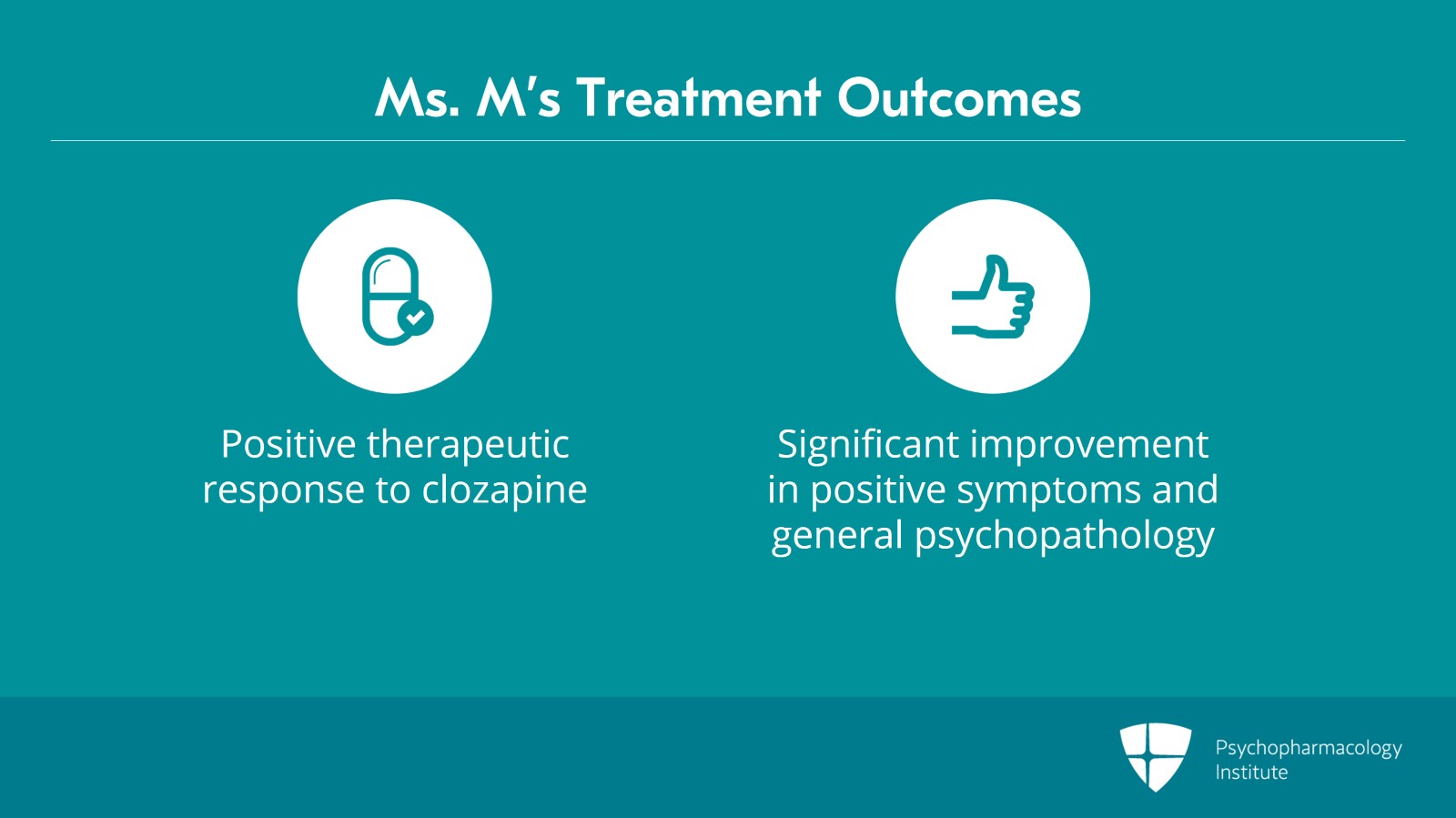
Ms. M had a positive therapeutic response to clozapine with improvement that was clinically significant both in terms of positive and general psychopathology.   And you know, I think this scenario is not altogether uncommon when we’re starting folks on clozapine and this is kind of a clean example without significant adverse effects of how this switch to clozapine can be achieved safely and fairly rapidly.
Free Files
Success!
Check your inbox, we sent you all the materials there.
Slide 23 of 24

So our key points here. A trial of clozapine should be strongly considered in all of our patients with treatment-resistant psychosis using evidence-based algorithms and expert consensus guidelines. So, I want to remind you that slow titration of clozapine often with divided dosing, as well as gradual tapering of the pre-clozapine antipsychotic, is strongly advised.

Slide 24 of 24

Free Files
Success!
Check your inbox, we sent you all the materials there.
Learning Objectives:

After completing this activity, the learner will be able to:

  1. Describe the indications and contraindications to antipsychotic switching.
  2. Recognize and utilize the different strategies to make a successful antipsychotic switch.
  3. Identify and manage the different problems that can occur during antipsychotic switching.

Original Release Date: 03/01/2022

Review and Re-release Date: 03/01/2024

Expiration Date: 04/01/2025

Expert: Brian Miller, M.D.

Medical Editor: Paz Badía, M.D.

Relevant Financial Disclosures:

The following planners, faculty, and reviewers have the following relevant financial relationships with commercial interests to disclose:

Dr. Miller has disclosed the following relationships:

  • NIMH: Investigator
  • Stanley Medical Research Institute: Investigator
  • Brain & Behavior Research Institute: Investigator
  • Augusta University: Faculty
  • Boehringer Ingelheim: Advisory Board
  • Psychiatric Times: Consulting
  • ClearView: Consulting
  • Atheneum: Consulting

All of the relevant financial relationships listed for these individuals have been mitigated.

Contact Information: For questions regarding the content or access to this activity, contact us at support@psychopharmacologyinstitute.com

Instructions for Participation and Credit:

Participants must complete the activity online during the valid credit period that is noted above.

Follow these steps to earn CME credit:

  1. View the required educational content provided on this course page.
  2. Complete the Post Activity Evaluation for providing the necessary feedback for continuing accreditation purposes and for the development of future activities. NOTE: Completing the Post Activity Evaluation after the quiz is required to receive the earned credit.
  3. Download your certificate.

Accreditation Statement

This activity has been planned and implemented in accordance with the accreditation requirements and policies of the Accreditation Council for Continuing Medical Education through the joint providership of Medical Academy LLC and the Psychopharmacology Institute. Medical Academy is accredited by the ACCME to provide continuing medical education for physicians.

Credit Designation Statement

Medical Academy designates this enduring activity for a maximum of 1.00 AMA PRA Category 1 credit(s). Physicians should claim only the credit commensurate with the extent of their participation in the activity.

Free Files
Success!
Check your inbox, we sent you all the materials there.
Continue in the website
Instant access modal

Become a Bronze, Silver, Gold, Bronze extended, Silver extended or Gold extended Member.

2025–26 Psychopharmacology CME Program

Unlock up to 155 CME Credits, including 40 SA CME Credits.