Close Banner
Section Free  - Video Lectures

05. Strategies for Antipsychotic Switching

Published on March 1, 2022 Expired on April 1, 2025

Brian Miller, M.D., Ph.D., M.P.H.

Professor - Augusta University

Key Points

  • The most common switch strategies are abrupt switch and cross-taper switch.
  • Other potential strategies include taper switch and plateau cross-taper switch.

Free Downloads for Offline Access

  • Free Download Presentation File (PPTX)
  • Free Download Audio File (MP3)
  • Free Download Video (MP4)

Slides and Transcript

Slide 1 of 14

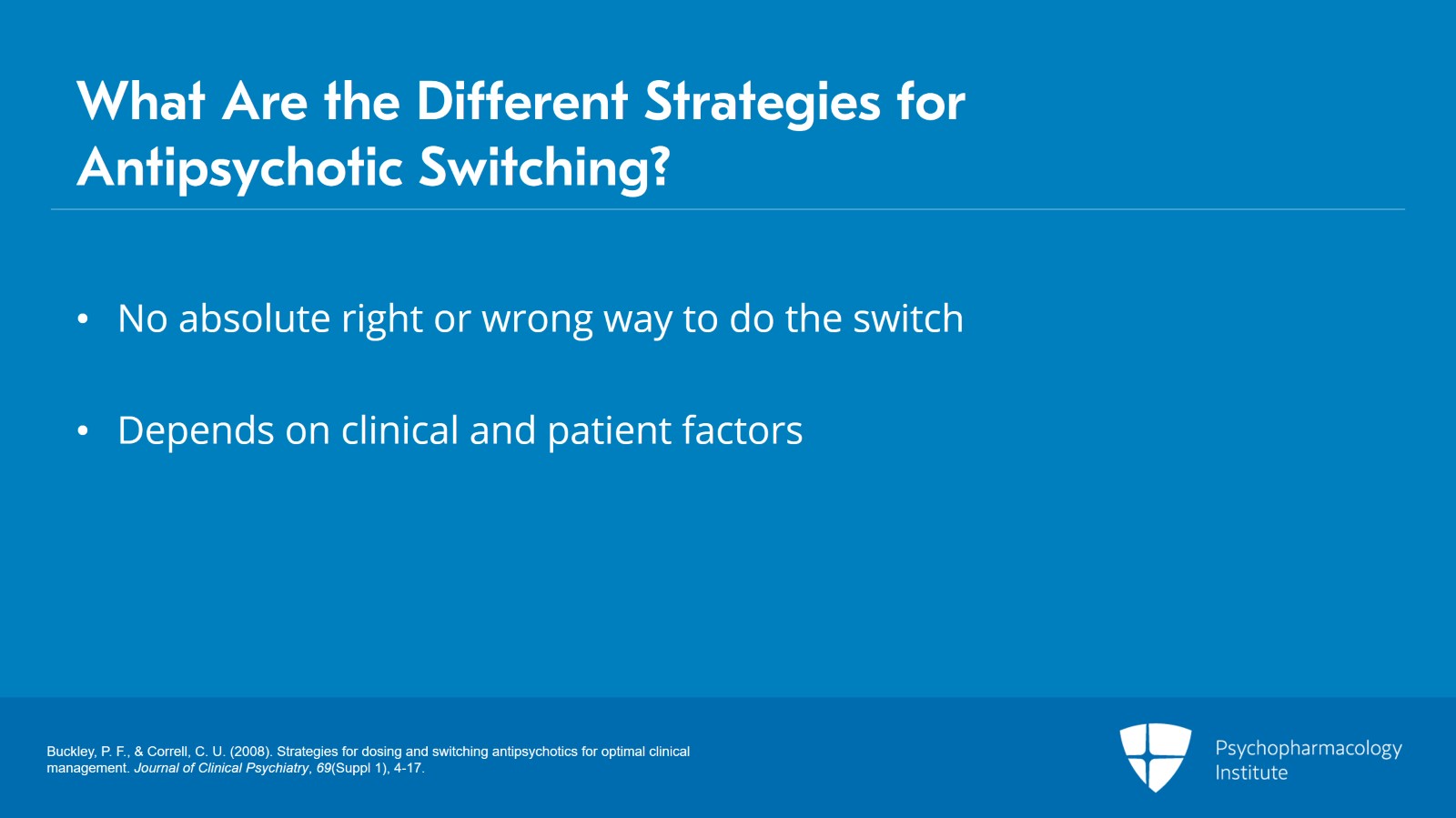
So now, we’re going to get into really a lot of the meat of the talk here and specifically now we’re going to talk about what are the different strategies for antipsychotic switching.

Slide 2 of 14

This is an extremely important clinical question. There’s not necessarily an absolute right or wrong way to do the switch. It depends on a number of clinical and patient factors but my goal here would be to discuss with you what are the different ways that we can make the switch.
References:
  • Buckley, P. F., & Correll, C. U. (2008). Strategies for dosing and switching antipsychotics for optimal clinical management. Journal of Clinical Psychiatry, 69(Suppl 1), 4-17.
Free Files
Success!
Check your inbox, we sent you all the materials there.

Slide 3 of 14

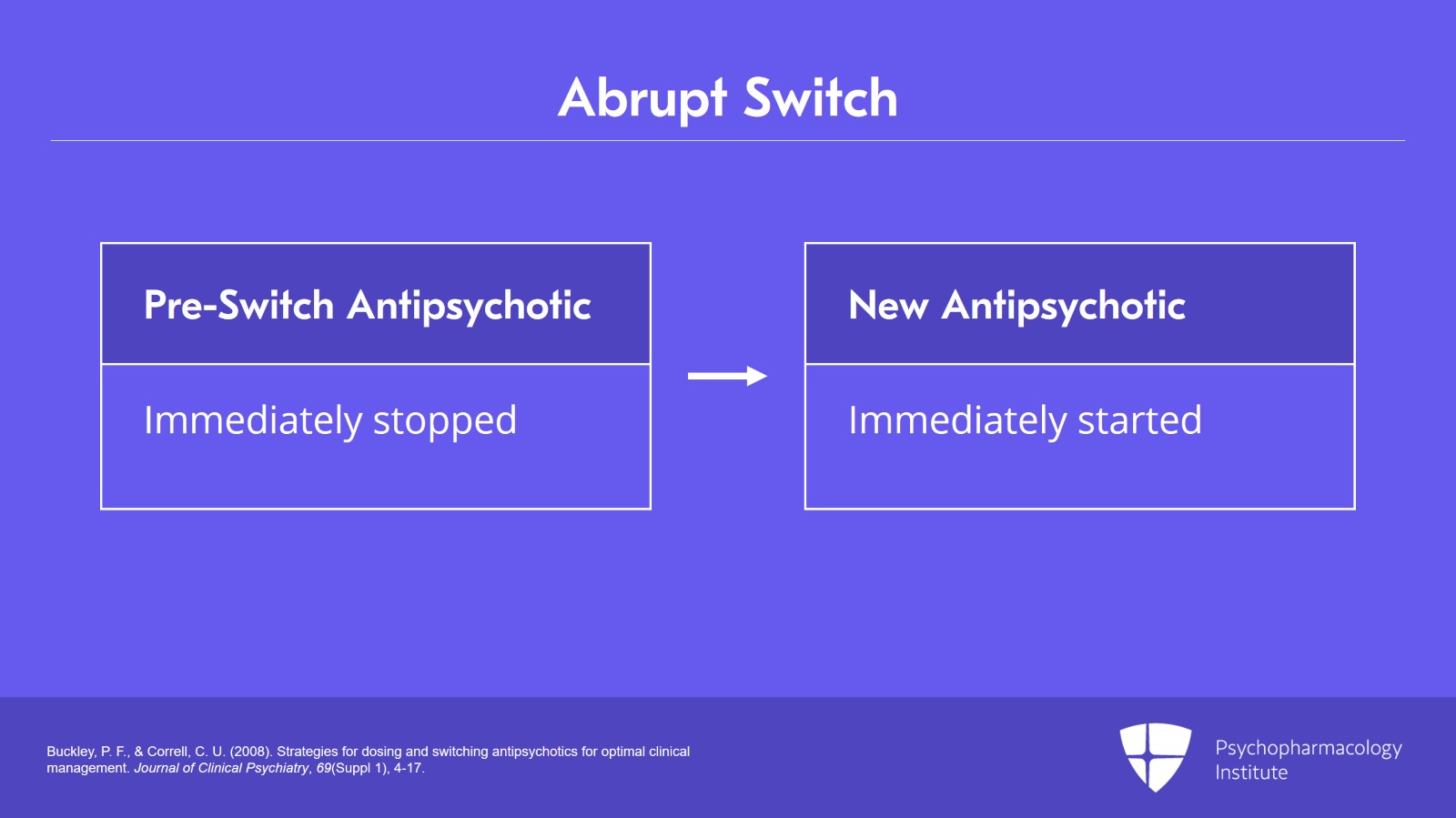
So the first switching strategy is just an abrupt switch, that is, the pre-switch antipsychotic is stopped immediately and then the new antipsychotic is started immediately.
References:
  • Buckley, P. F., & Correll, C. U. (2008). Strategies for dosing and switching antipsychotics for optimal clinical management. Journal of Clinical Psychiatry, 69(Suppl 1), 4-17.

Slide 4 of 14

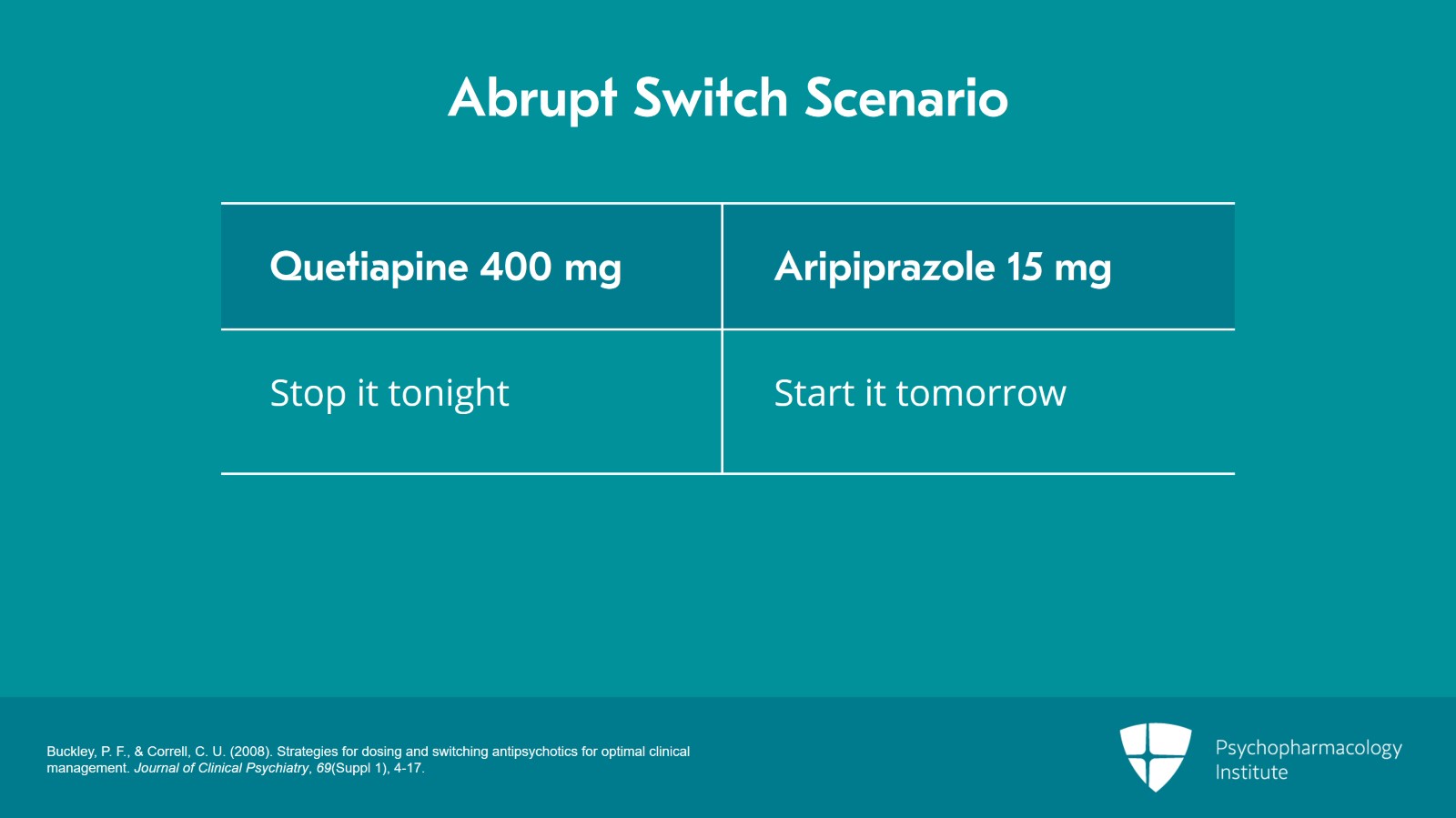
So this is a very common approach in clinical trials. So for example, a patient is taking 400 mg of quetiapine. They are going to be switched to 15 mg of aripiprazole. And in this abrupt switch scenario, the patient is simply advised to “okay, go ahead and stop the quetiapine. Don’t take any tonight. And then tomorrow, you’re going to start on the new medication, the aripiprazole.”
References:
  • Buckley, P. F., & Correll, C. U. (2008). Strategies for dosing and switching antipsychotics for optimal clinical management. Journal of Clinical Psychiatry, 69(Suppl 1), 4-17.
Free Files
Success!
Check your inbox, we sent you all the materials there.

Slide 5 of 14

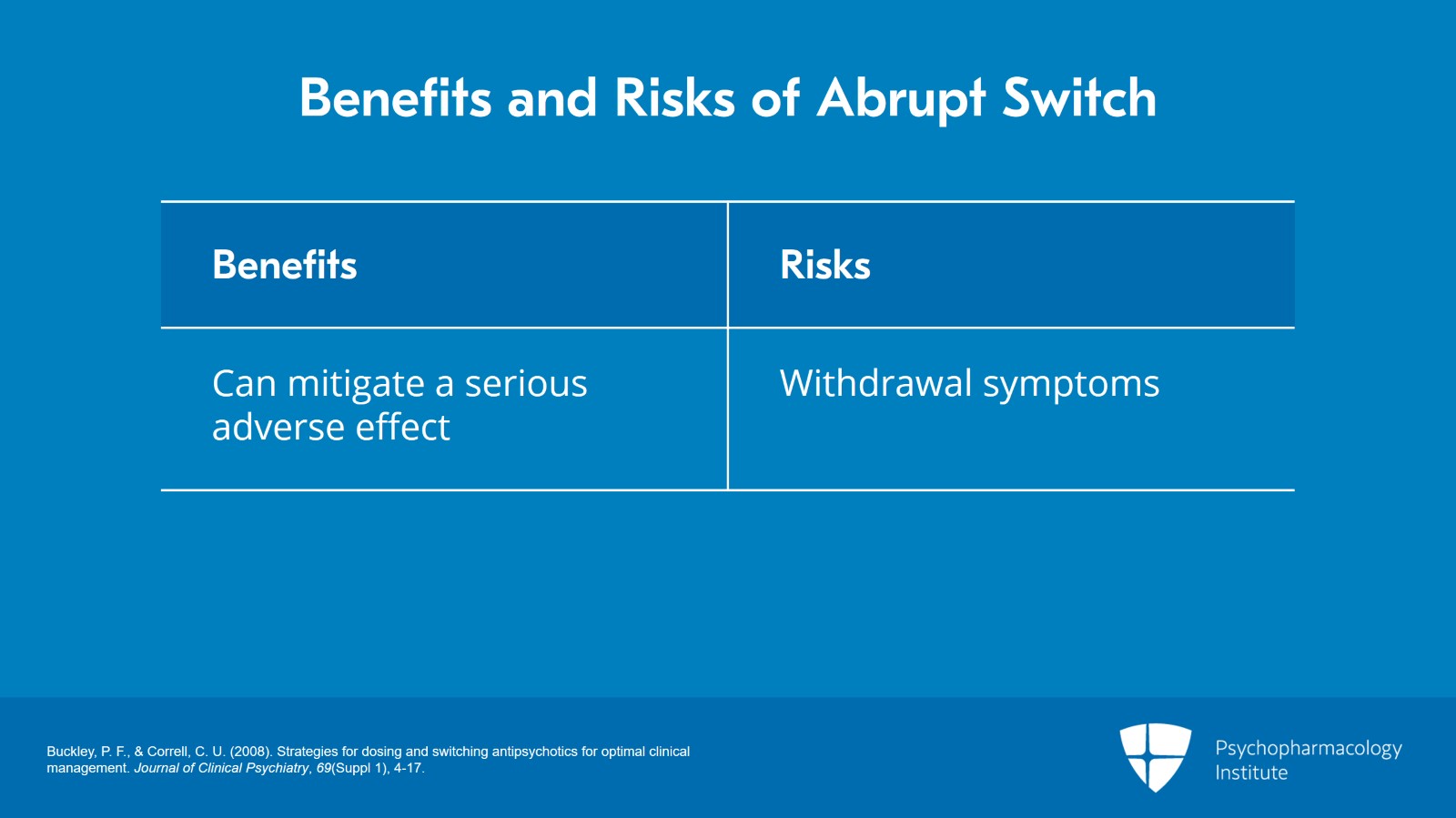
This method can be good in terms of trying to mitigate a potential serious adverse effect. An example being a patient we’re concerned about the possibility of agranulocytosis with clozapine, we would simply immediately discontinue that medication. However, as you can imagine, it carries a higher risk of withdrawal symptoms if we just abruptly stop the pre-switch antipsychotic. But this is a very common straightforward approach to switching, stop one, start the other.
References:
  • Buckley, P. F., & Correll, C. U. (2008). Strategies for dosing and switching antipsychotics for optimal clinical management. Journal of Clinical Psychiatry, 69(Suppl 1), 4-17.

Slide 6 of 14

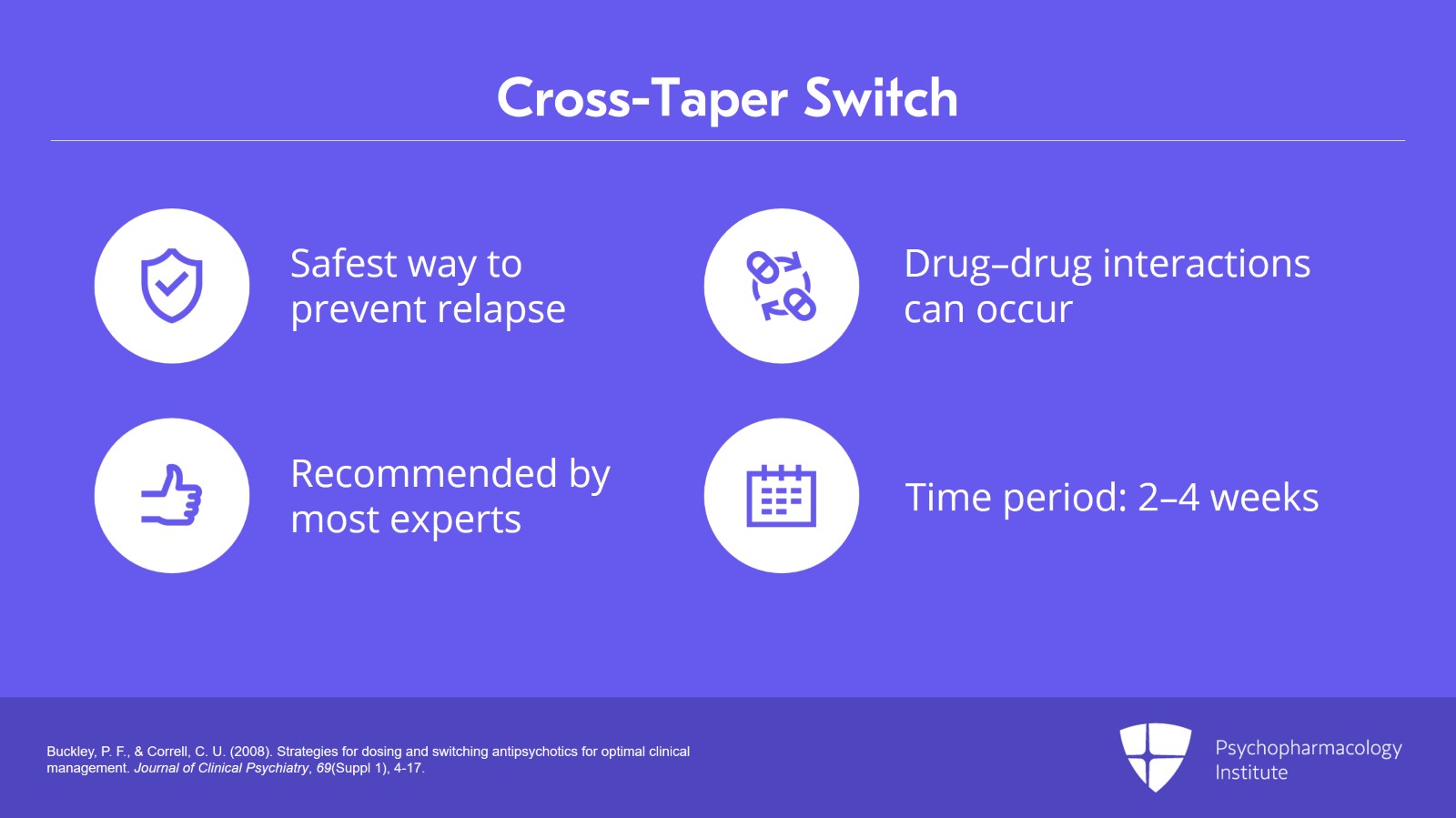
A second strategy is the so-called cross-taper switch which is arguably the safest way to prevent relapse that is illness exacerbation despite a gradual cross-taper. You know, drug-drug interactions are still possible. This is recommended by many experts in the field. The typical time period for such a switch is two to four weeks.
References:
  • Buckley, P. F., & Correll, C. U. (2008). Strategies for dosing and switching antipsychotics for optimal clinical management. Journal of Clinical Psychiatry, 69(Suppl 1), 4-17.
Free Files
Success!
Check your inbox, we sent you all the materials there.

Slide 7 of 14

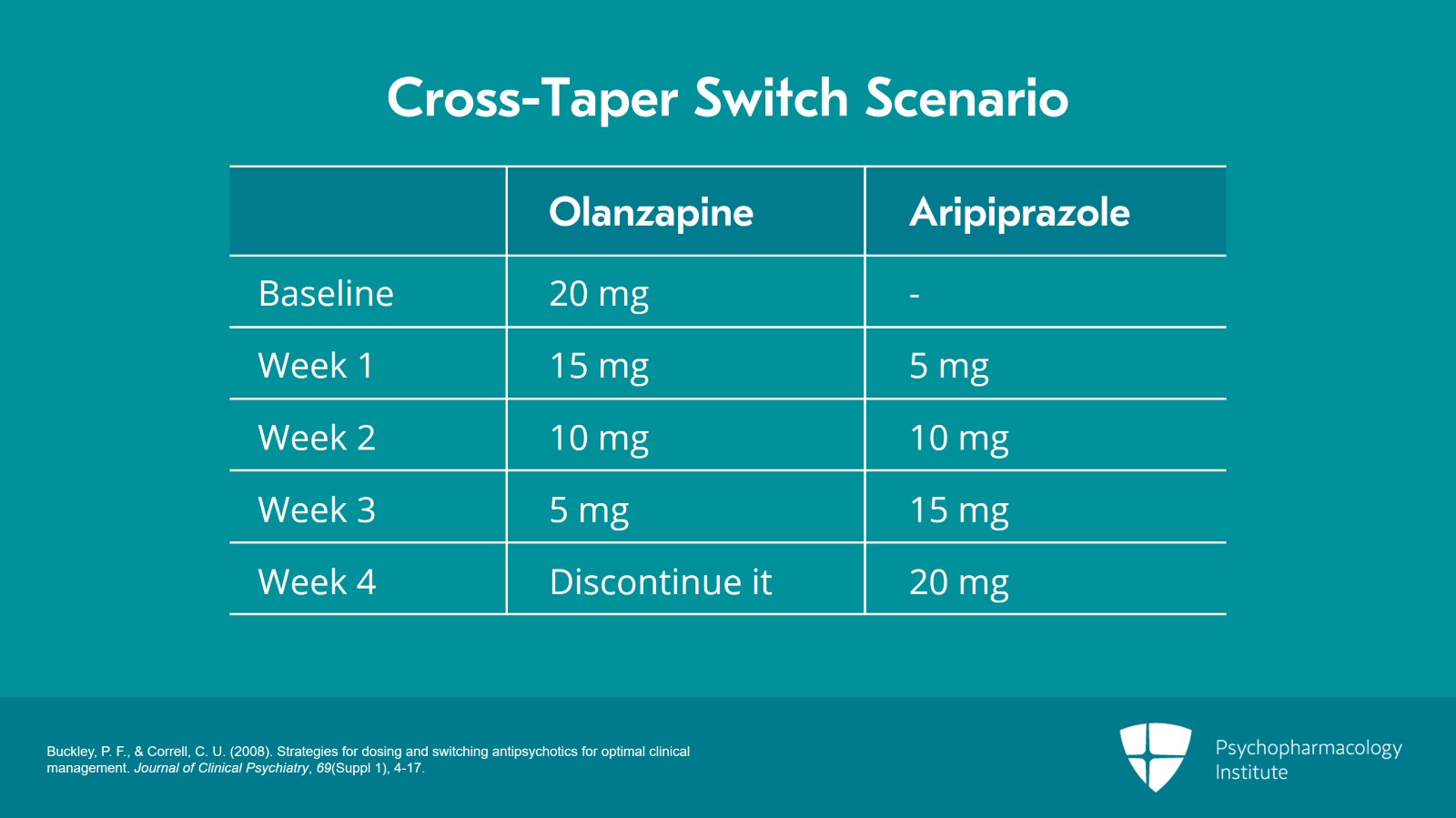
So, for example, a patient is taking 20 mg of olanzapine at baseline. We decide to switch them to aripiprazole over a period of three to four weeks. And so what you might do is taper off, of the olanzapine by 5 mg to 15 mg daily on week one, 10 mg daily on week two, 5 mg daily on week three, and then discontinuing the olanzapine on week four. And then on the flip side, the aripiprazole might be started at 5 mg on week one, 10 mg on week two, 15 mg on week three, and then up to maybe a target dose of 20 mg on week four. And so that’s the gradual cross-taper switch.
References:
  • Buckley, P. F., & Correll, C. U. (2008). Strategies for dosing and switching antipsychotics for optimal clinical management. Journal of Clinical Psychiatry, 69(Suppl 1), 4-17.

Slide 8 of 14

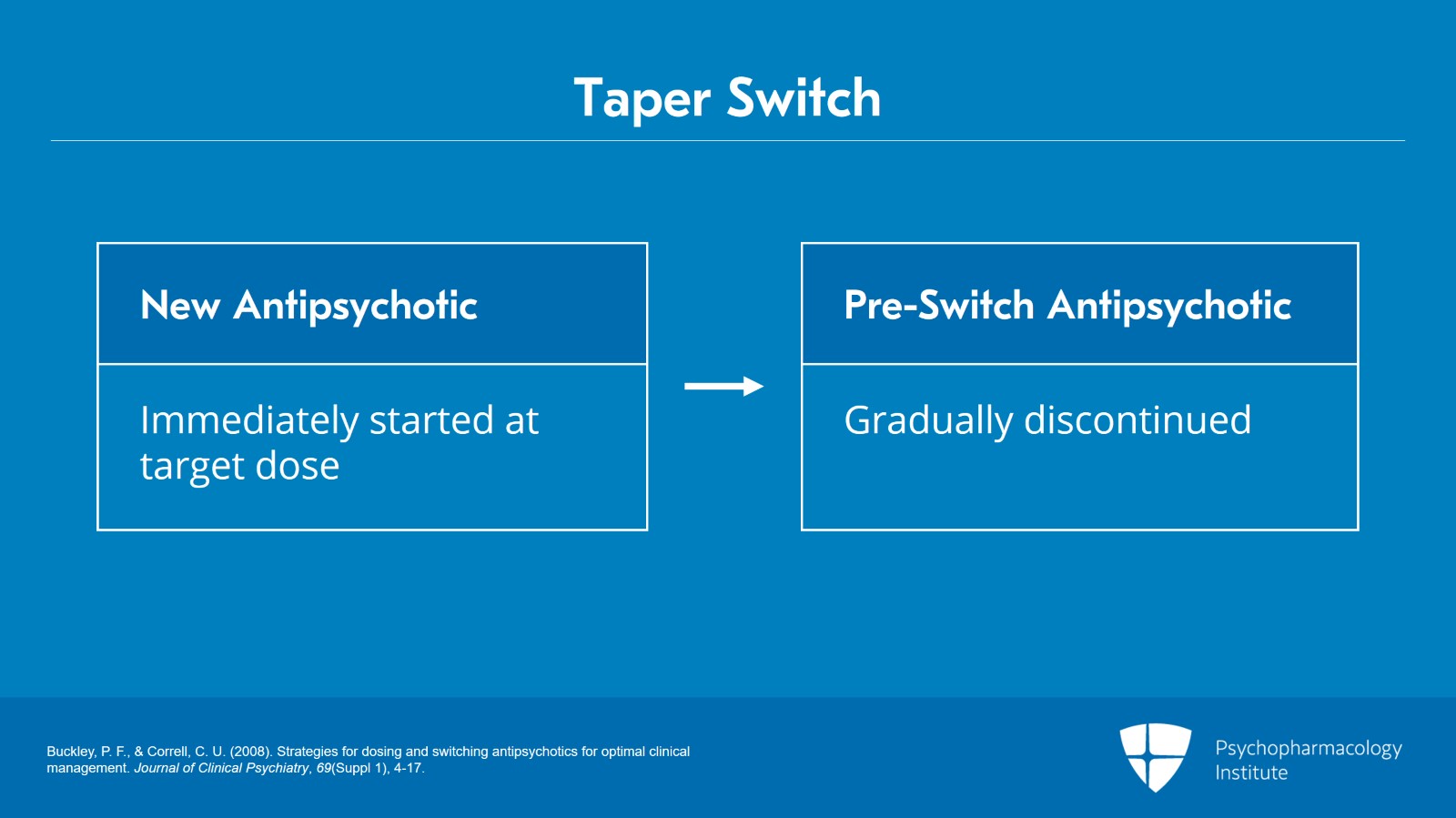
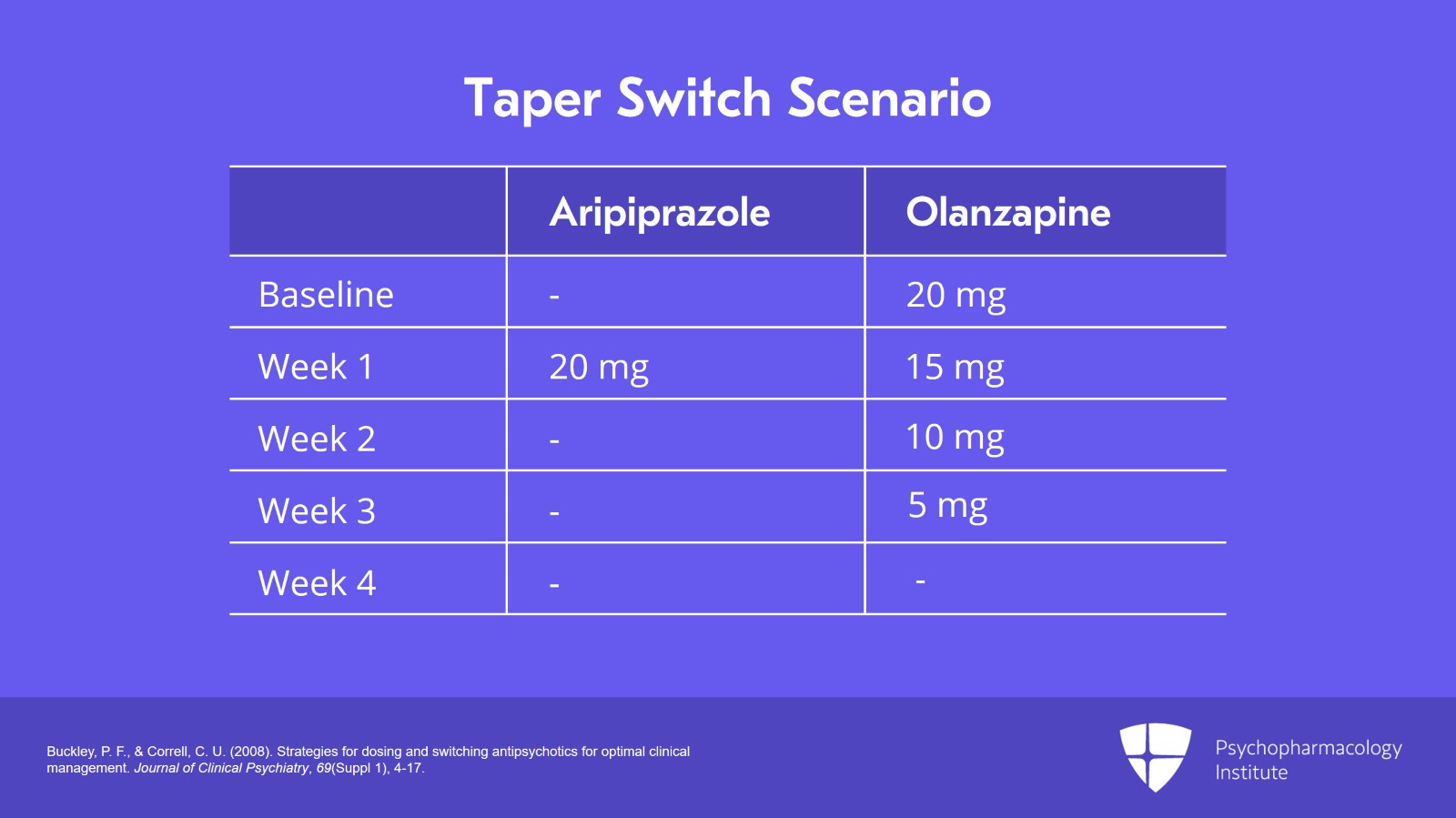
A third strategy is the so-called taper switch which involves immediately starting the new antipsychotic at the target dose and then gradually discontinuing the pre-switch antipsychotic.
References:
  • Buckley, P. F., & Correll, C. U. (2008). Strategies for dosing and switching antipsychotics for optimal clinical management. Journal of Clinical Psychiatry, 69(Suppl 1), 4-17.
Free Files
Success!
Check your inbox, we sent you all the materials there.

Slide 9 of 14

So for example, 20 mg of aripiprazole is started immediately and then the olanzapine is tapered off by 5 mg per week over a period of four weeks.  
References:
  • Buckley, P. F., & Correll, C. U. (2008). Strategies for dosing and switching antipsychotics for optimal clinical management. Journal of Clinical Psychiatry, 69(Suppl 1), 4-17.

Slide 10 of 14

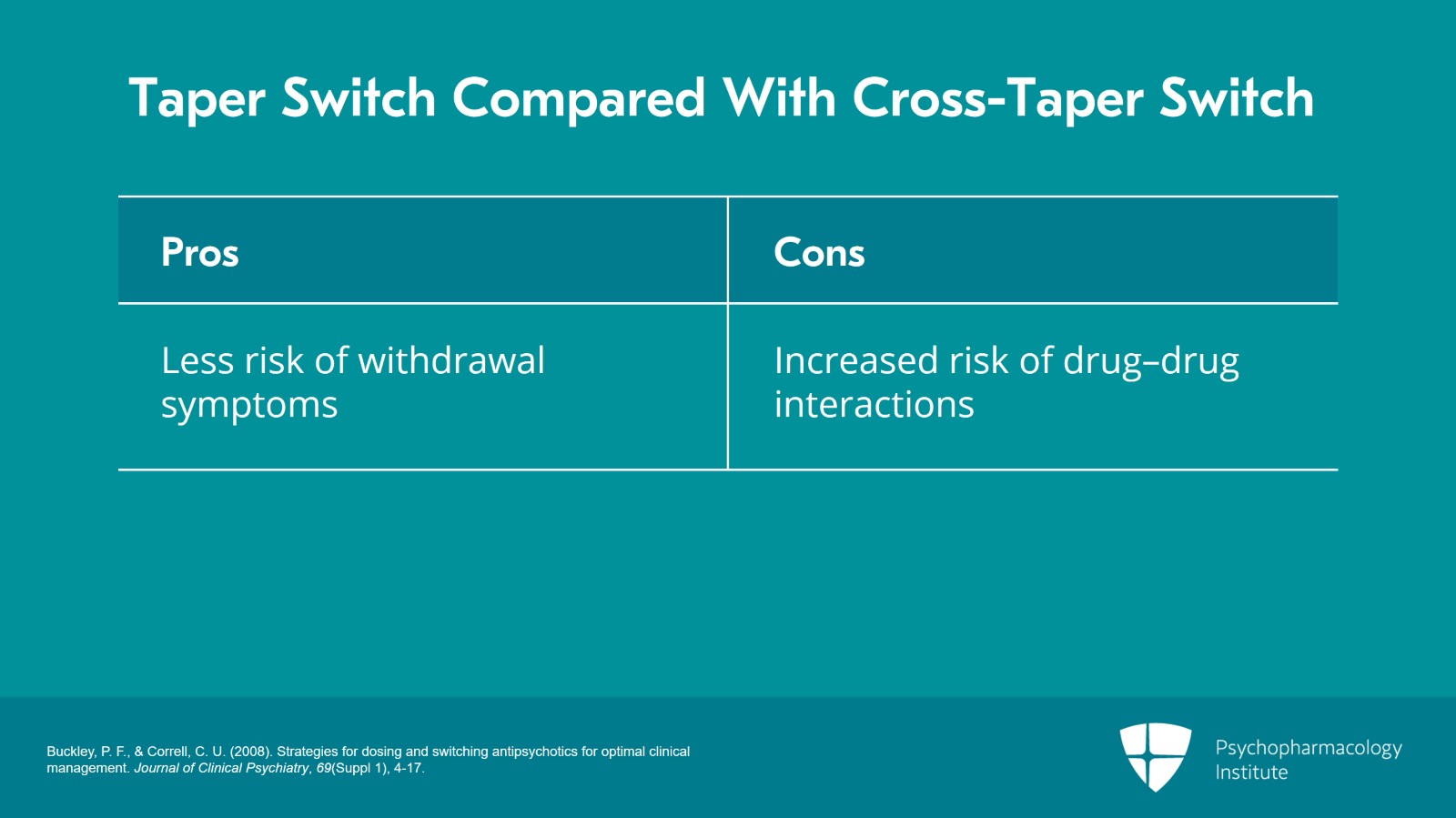
So when you compare this taper switch to the cross-taper switch, there’s less risk of withdrawal symptoms because the new antipsychotic is started at the target dose. However, that also may increase the risk of drug–drug interactions.
References:
  • Buckley, P. F., & Correll, C. U. (2008). Strategies for dosing and switching antipsychotics for optimal clinical management. Journal of Clinical Psychiatry, 69(Suppl 1), 4-17.
Free Files
Success!
Check your inbox, we sent you all the materials there.

Slide 11 of 14

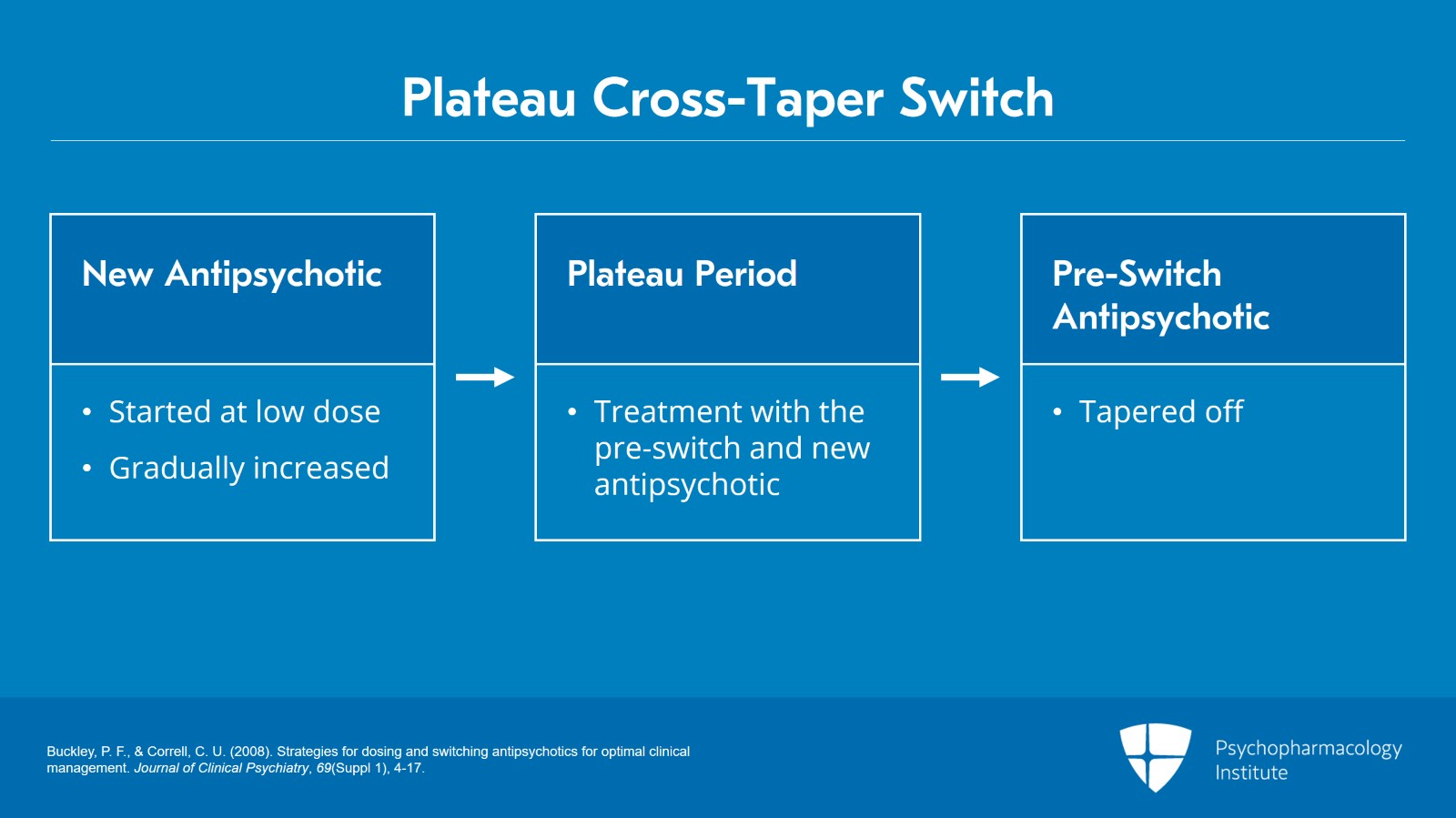
And then the final switch strategy that we’ll talk about is the plateau cross-taper switch. This is a very common approach when we switch patients to clozapine. In this scenario, the new antipsychotic is started at a low dose and gradually increased and then there’s a period where there’s a plateau where the patient is being treated with both the pre-switch and the new antipsychotic at the same time for a period and only then is the pre-switch antipsychotic tapered off.
References:
  • Buckley, P. F., & Correll, C. U. (2008). Strategies for dosing and switching antipsychotics for optimal clinical management. Journal of Clinical Psychiatry, 69(Suppl 1), 4-17.

Slide 12 of 14

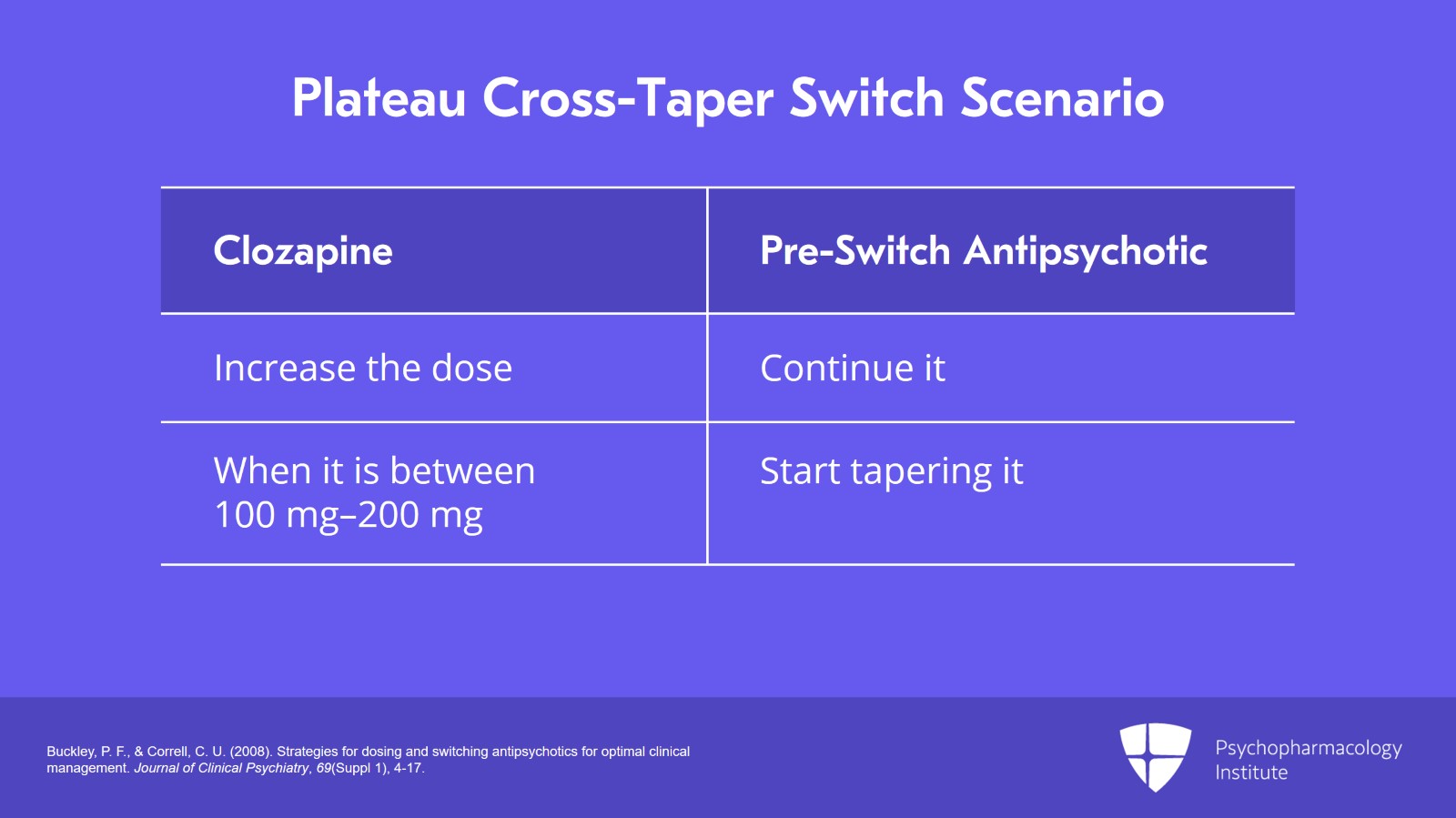
So you know, I alluded to clozapine. It’s not uncommon that when switching to clozapine, for example, a patient is continued on their pre-switch antipsychotic as we’re increasing the dose of clozapine and only after we get to doses of, you know, between say 100 to 200 mg of clozapine do we then start tapering the patient off of the pre-switch antipsychotic.
References:
  • Buckley, P. F., & Correll, C. U. (2008). Strategies for dosing and switching antipsychotics for optimal clinical management. Journal of Clinical Psychiatry, 69(Suppl 1), 4-17.
Free Files
Success!
Check your inbox, we sent you all the materials there.

Slide 13 of 14

So the key points here. The two most common switch strategies include the abrupt switch and the cross-taper switch but other potential strategies include both the taper switch and the plateau cross-taper switch.

Slide 14 of 14

Free Files
Success!
Check your inbox, we sent you all the materials there.

Learning Objectives:

After completing this activity, the learner will be able to:

  1. Describe the indications and contraindications to antipsychotic switching.
  2. Recognize and utilize the different strategies to make a successful antipsychotic switch.
  3. Identify and manage the different problems that can occur during antipsychotic switching.

Original Release Date: 03/01/2022

Review and Re-release Date: 03/01/2024

Expiration Date: 04/01/2025

Expert: Brian Miller, M.D.

Medical Editor: Paz Badía, M.D.

Relevant Financial Disclosures:

The following planners, faculty, and reviewers have the following relevant financial relationships with commercial interests to disclose:

Dr. Miller has disclosed the following relationships:

  • NIMH: Investigator
  • Stanley Medical Research Institute: Investigator
  • Brain & Behavior Research Institute: Investigator
  • Augusta University: Faculty
  • Boehringer Ingelheim: Advisory Board
  • Psychiatric Times: Consulting
  • ClearView: Consulting
  • Atheneum: Consulting

All of the relevant financial relationships listed for these individuals have been mitigated.

Contact Information: For questions regarding the content or access to this activity, contact us at support@psychopharmacologyinstitute.com

Instructions for Participation and Credit:

Participants must complete the activity online during the valid credit period that is noted above.

Follow these steps to earn CME credit:

  1. View the required educational content provided on this course page.
  2. Complete the Post Activity Evaluation for providing the necessary feedback for continuing accreditation purposes and for the development of future activities. NOTE: Completing the Post Activity Evaluation after the quiz is required to receive the earned credit.
  3. Download your certificate.

Accreditation Statement

This activity has been planned and implemented in accordance with the accreditation requirements and policies of the Accreditation Council for Continuing Medical Education through the joint providership of Medical Academy LLC and the Psychopharmacology Institute. Medical Academy is accredited by the ACCME to provide continuing medical education for physicians.

Credit Designation Statement

Medical Academy designates this enduring activity for a maximum of 1.00 AMA PRA Category 1 credit(s). Physicians should claim only the credit commensurate with the extent of their participation in the activity.


Free Files
Success!
Check your inbox, we sent you all the materials there.
Continue in the website
Instant access modal

Become a Bronze, Silver, Gold, Bronze extended, Silver extended or Gold extended Member.

2025–26 Psychopharmacology CME Program

Unlock up to 155 CME Credits, including 40 SA CME Credits.