Close Banner
Section Free  - Video Lectures

06. Understanding the Evidence for CBD

Published on October 1, 2021 Expired on April 1, 2025

Diana Martinez, M.D.

Professor of Psychiatry - Columbia University Irving Medical Center

Key Points

  • The strongest evidence for CBD is in reducing seizures in childhood epilepsy. 
  • CBD might help with symptoms of schizophrenia, especially the positive symptoms of psychosis.
  • CBD may be helpful for social anxiety disorder, opioid use disorder, and CUD.
  • There is a need to replicate these studies and look at potential CBD effects in larger studies.

Free Downloads for Offline Access

  • Free Download Presentation File (PPTX)
  • Free Download Audio File (MP3)
  • Free Download Video (MP4)

Slides and Transcript
Slide 1 of 16

Video 6: Understanding the Evidence for CBD.

Slide 2 of 16

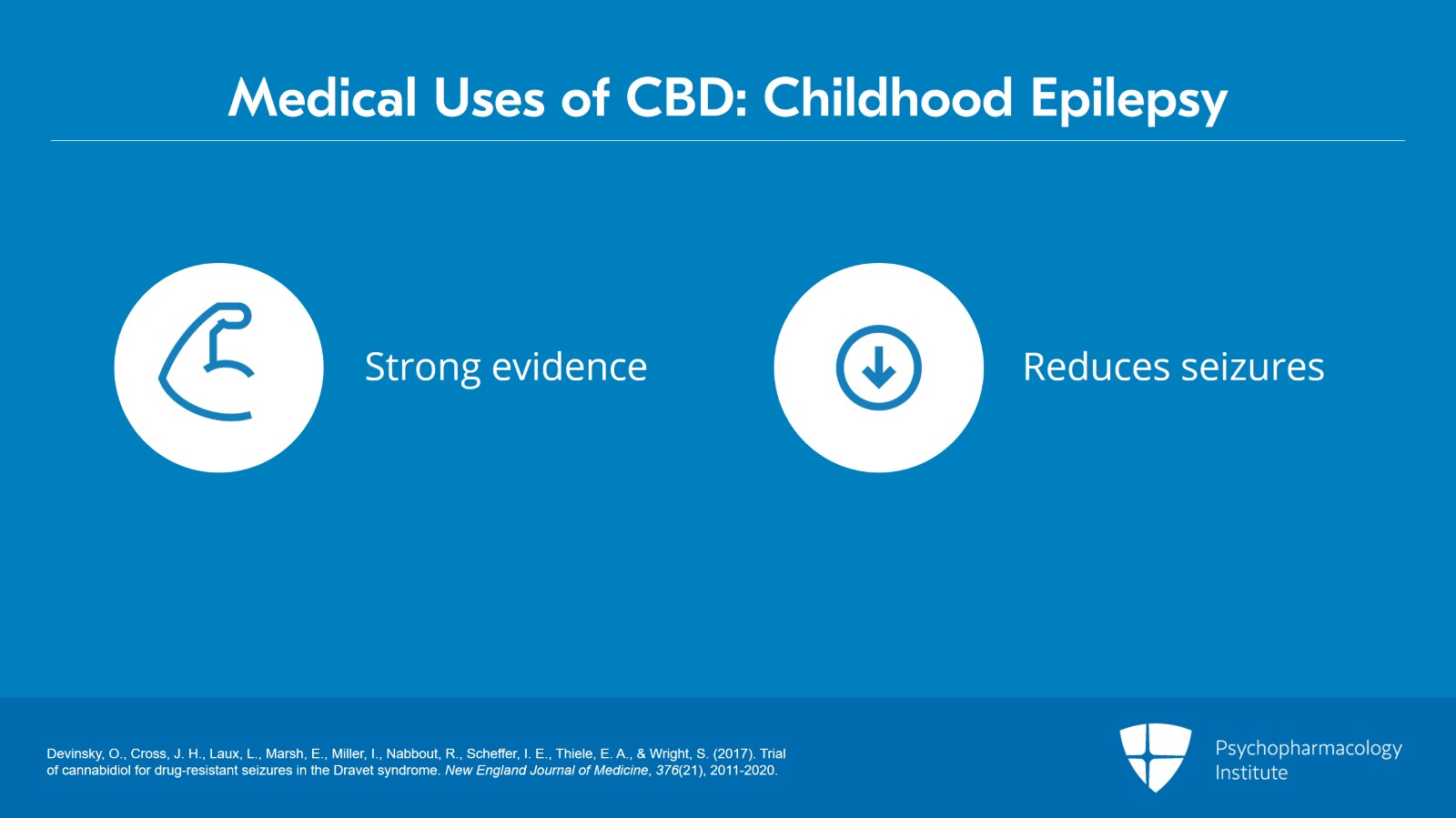
Now, I’ll review the study supporting the use of CBD as a medication. The strongest support for the medical use of CBD is childhood epilepsy reducing seizures, caused by Dravet syndrome or Lennox-Gastaut syndrome.
References:
  • Devinsky, O., Cross, J. H., Laux, L., Marsh, E., Miller, I., Nabbout, R., Scheffer, I. E., Thiele, E. A., & Wright, S. (2017). Trial of cannabidiol for drug-resistant seizures in the Dravet syndrome. New England Journal of Medicine, 376(21), 2011-2020.
Free Files
Success!
Check your inbox, we sent you all the materials there.
Slide 3 of 16

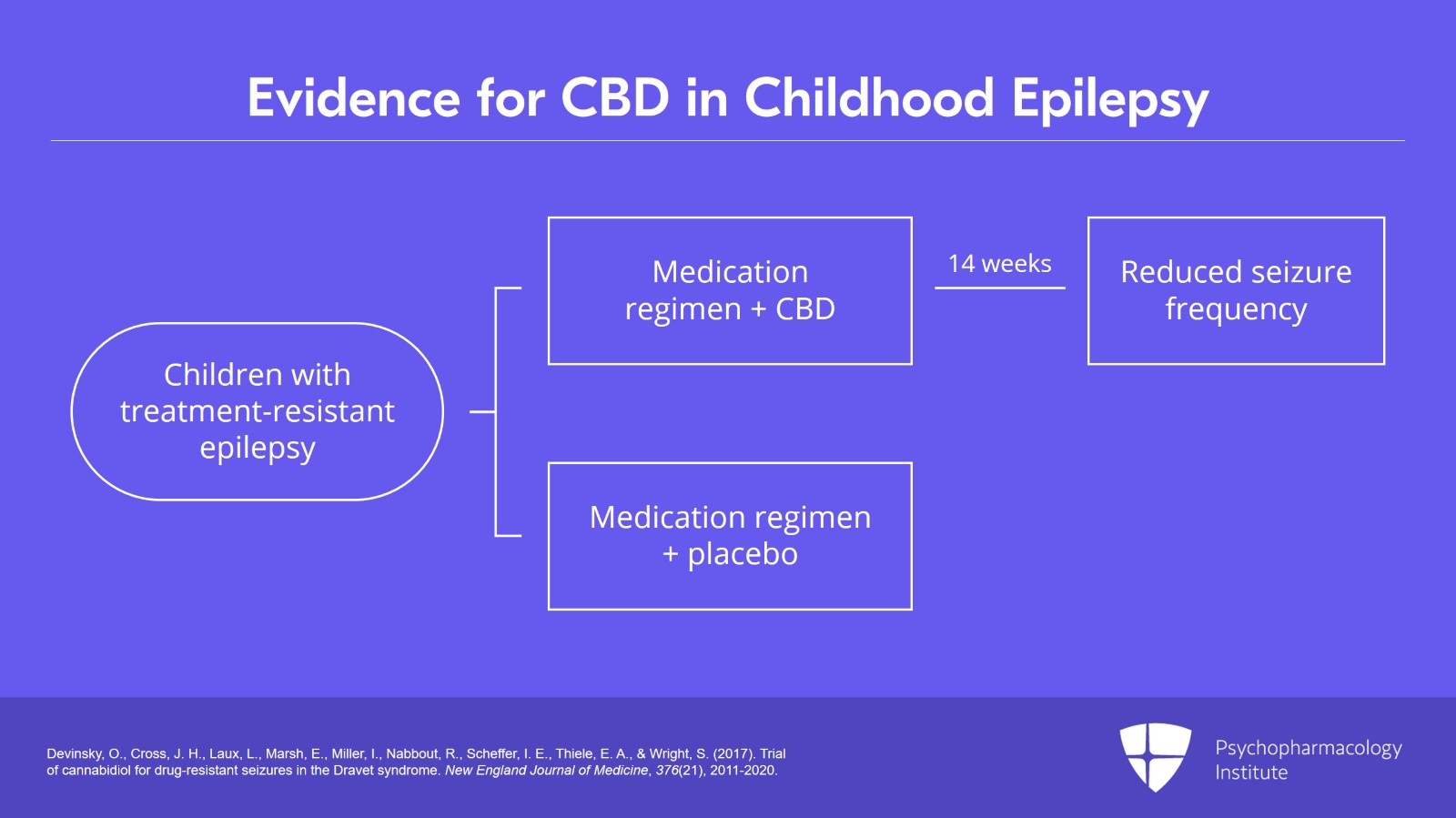
In a large randomized placebo-controlled trial that included treatment-resistant children, CBD additional to their ongoing medication regimen, administered at 20 mg/kg for 14 weeks, reduced seizure frequency by 50%, and was superior to placebo.
References:
  • Devinsky, O., Cross, J. H., Laux, L., Marsh, E., Miller, I., Nabbout, R., Scheffer, I. E., Thiele, E. A., & Wright, S. (2017). Trial of cannabidiol for drug-resistant seizures in the Dravet syndrome. New England Journal of Medicine, 376(21), 2011-2020.

Slide 4 of 16

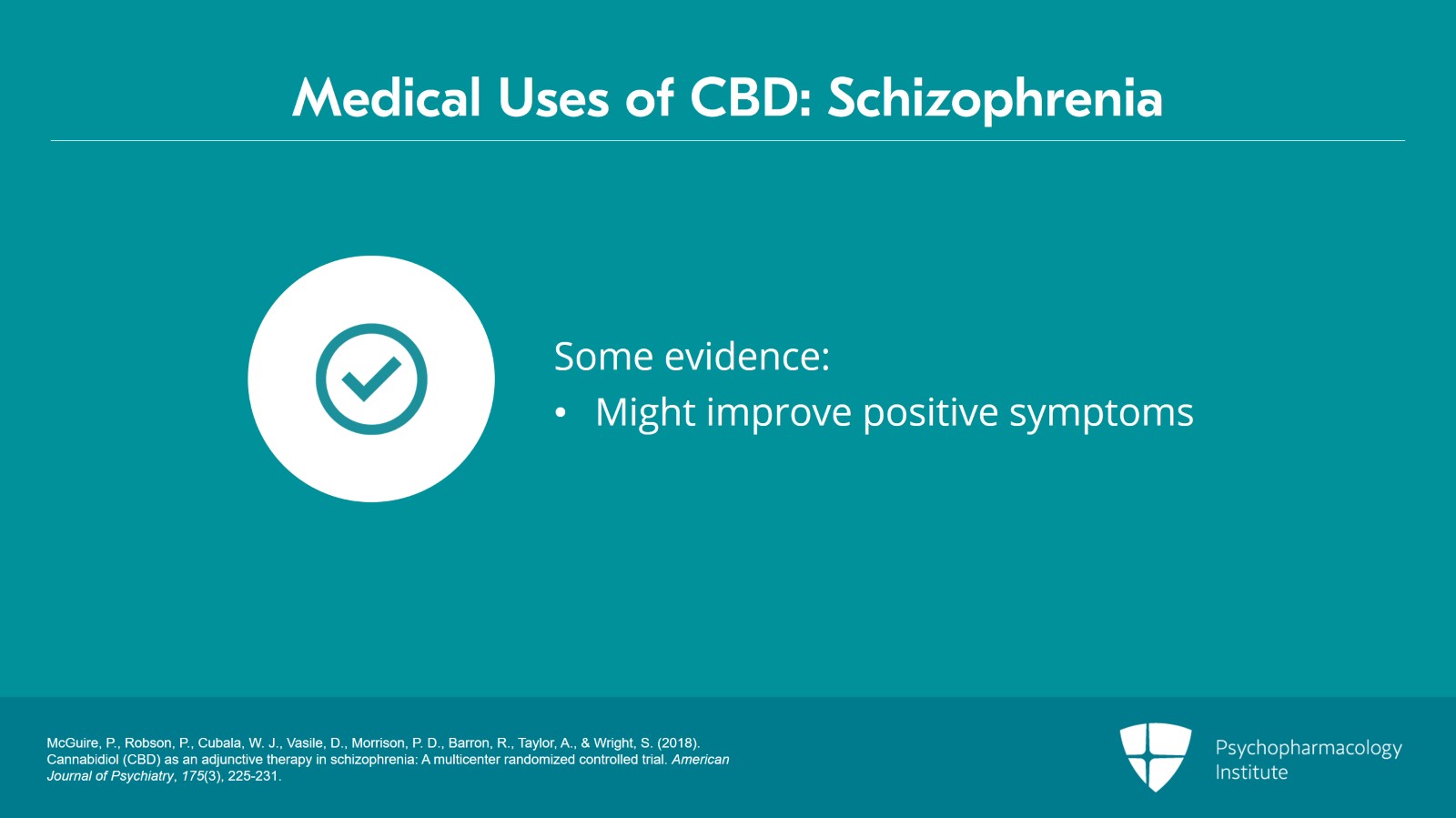
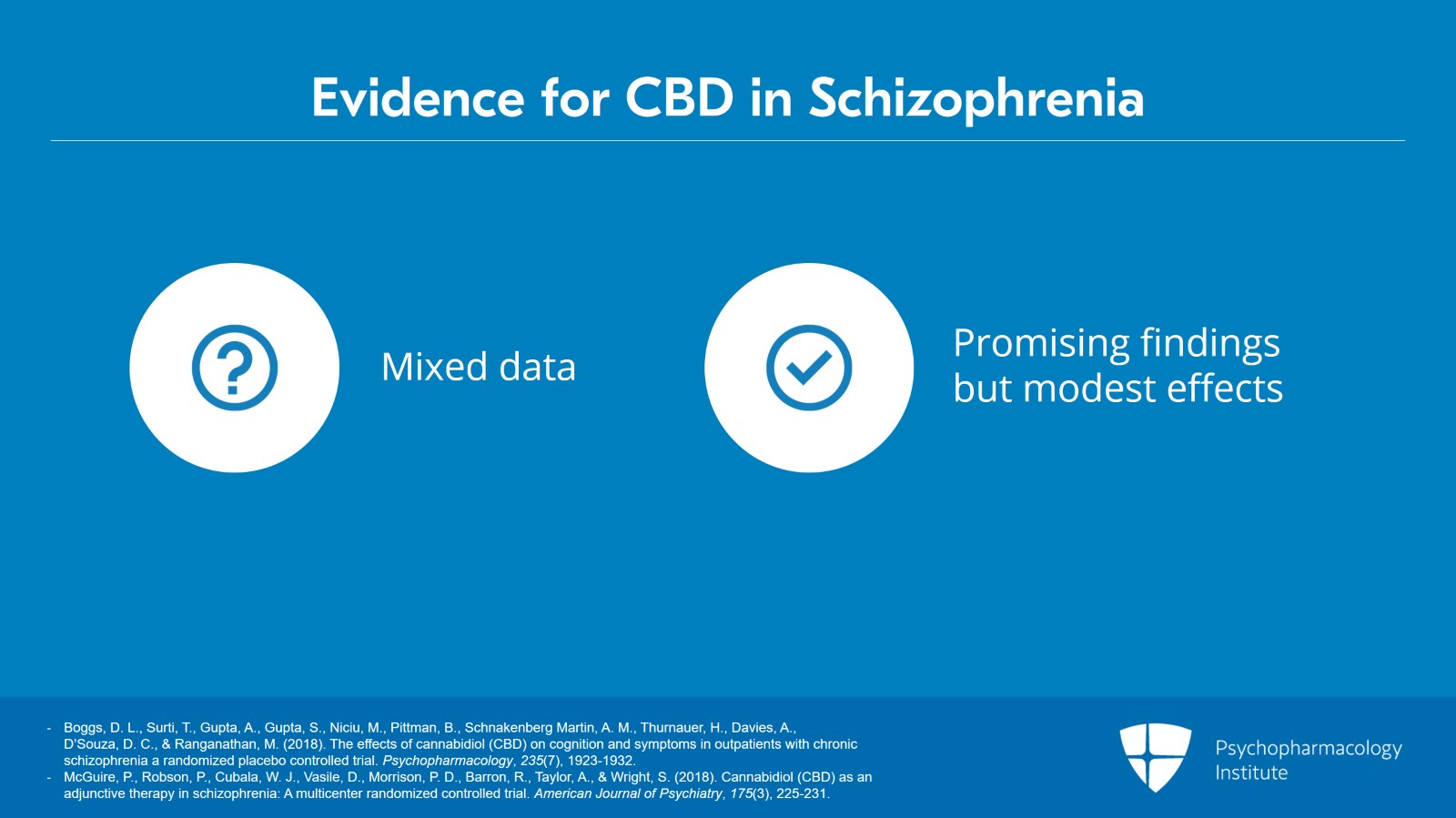
When it comes to schizophrenia, there is some early evidence that CBD might help improve the positive symptoms in this disorder.
References:
  • McGuire, P., Robson, P., Cubala, W. J., Vasile, D., Morrison, P. D., Barron, R., Taylor, A., & Wright, S. (2018). Cannabidiol (CBD) as an adjunctive therapy in schizophrenia: A multicenter randomized controlled trial. American Journal of Psychiatry, 175(3), 225-231.
Free Files
Success!
Check your inbox, we sent you all the materials there.
Slide 5 of 16

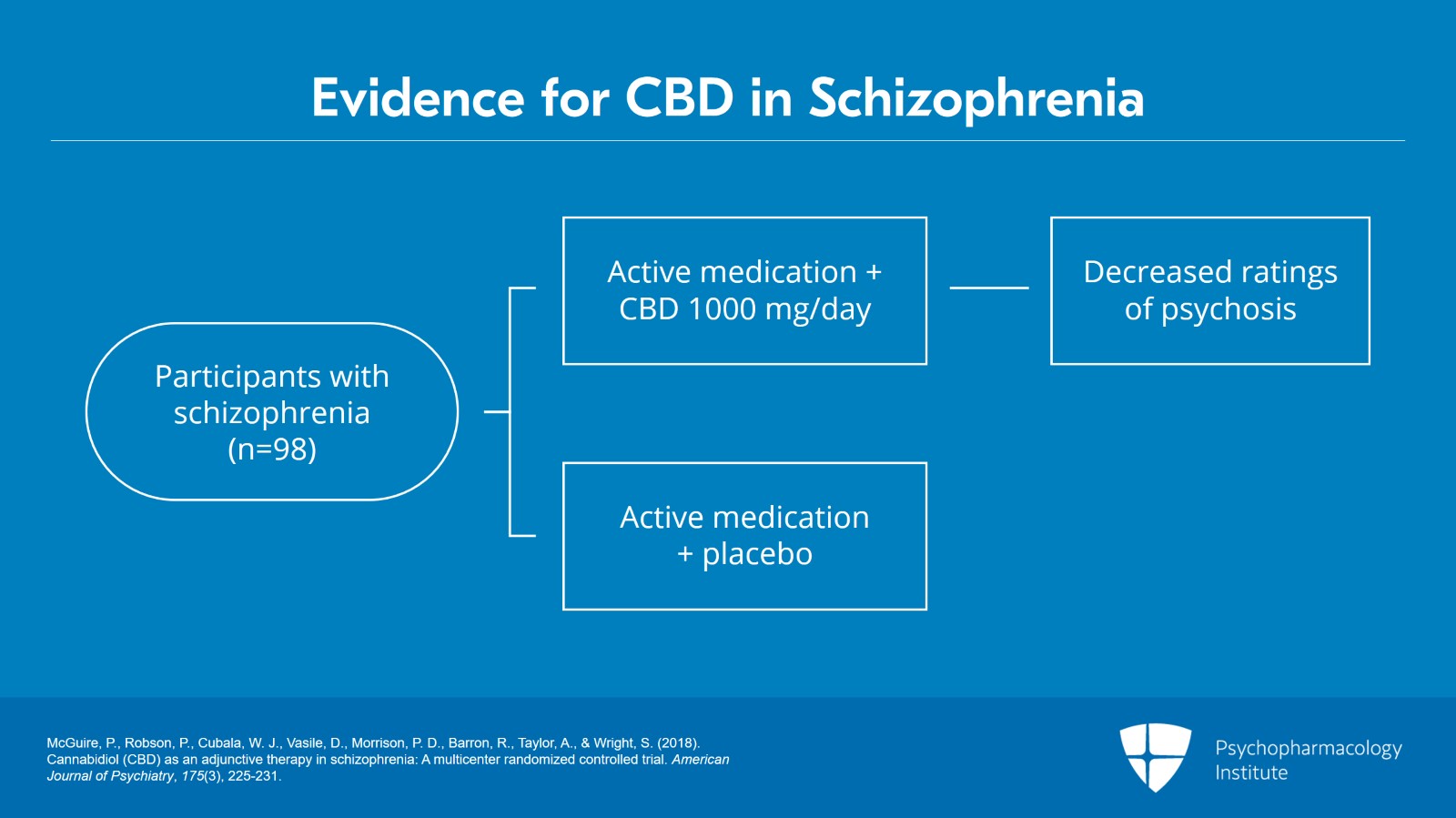
One study tested CBD in 98 participants with schizophrenia. All subjects were on active medication for schizophrenia but still had positive symptoms. Patients were randomized to 1000 mg a day versus placebo. The results show that CBD decreased ratings of psychosis over placebo.
References:
  • McGuire, P., Robson, P., Cubala, W. J., Vasile, D., Morrison, P. D., Barron, R., Taylor, A., & Wright, S. (2018). Cannabidiol (CBD) as an adjunctive therapy in schizophrenia: A multicenter randomized controlled trial. American Journal of Psychiatry, 175(3), 225-231.

Slide 6 of 16

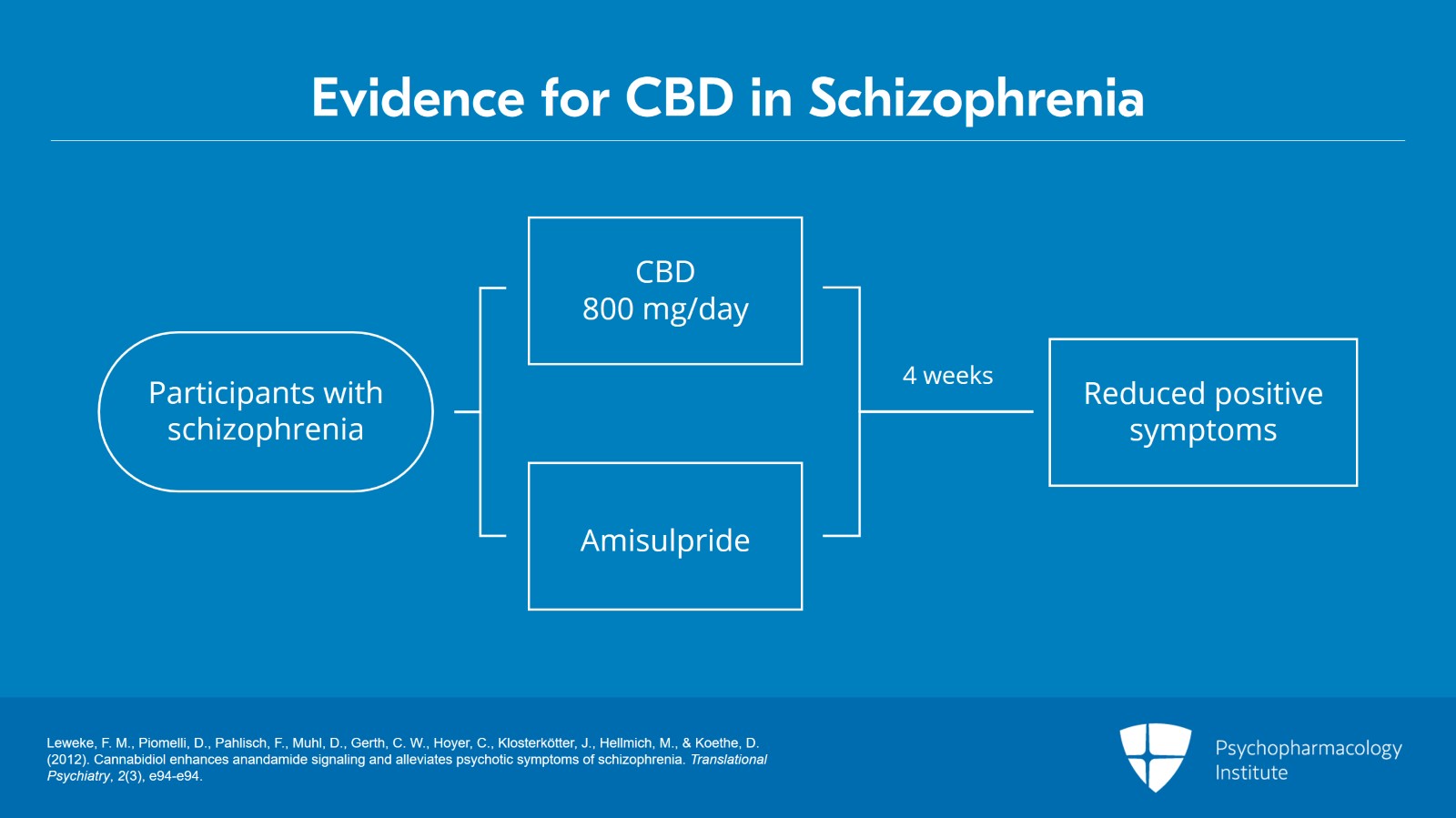
Another study compared CBD dosed at 800 mg a day to amisulpride for four weeks and showed that both medications reduced the positive symptoms of schizophrenia.
References:
  • Leweke, F. M., Piomelli, D., Pahlisch, F., Muhl, D., Gerth, C. W., Hoyer, C., Klosterkötter, J., Hellmich, M., & Koethe, D. (2012). Cannabidiol enhances anandamide signaling and alleviates psychotic symptoms of schizophrenia. Translational Psychiatry, 2(3), e94-e94.
Free Files
Success!
Check your inbox, we sent you all the materials there.
Slide 7 of 16

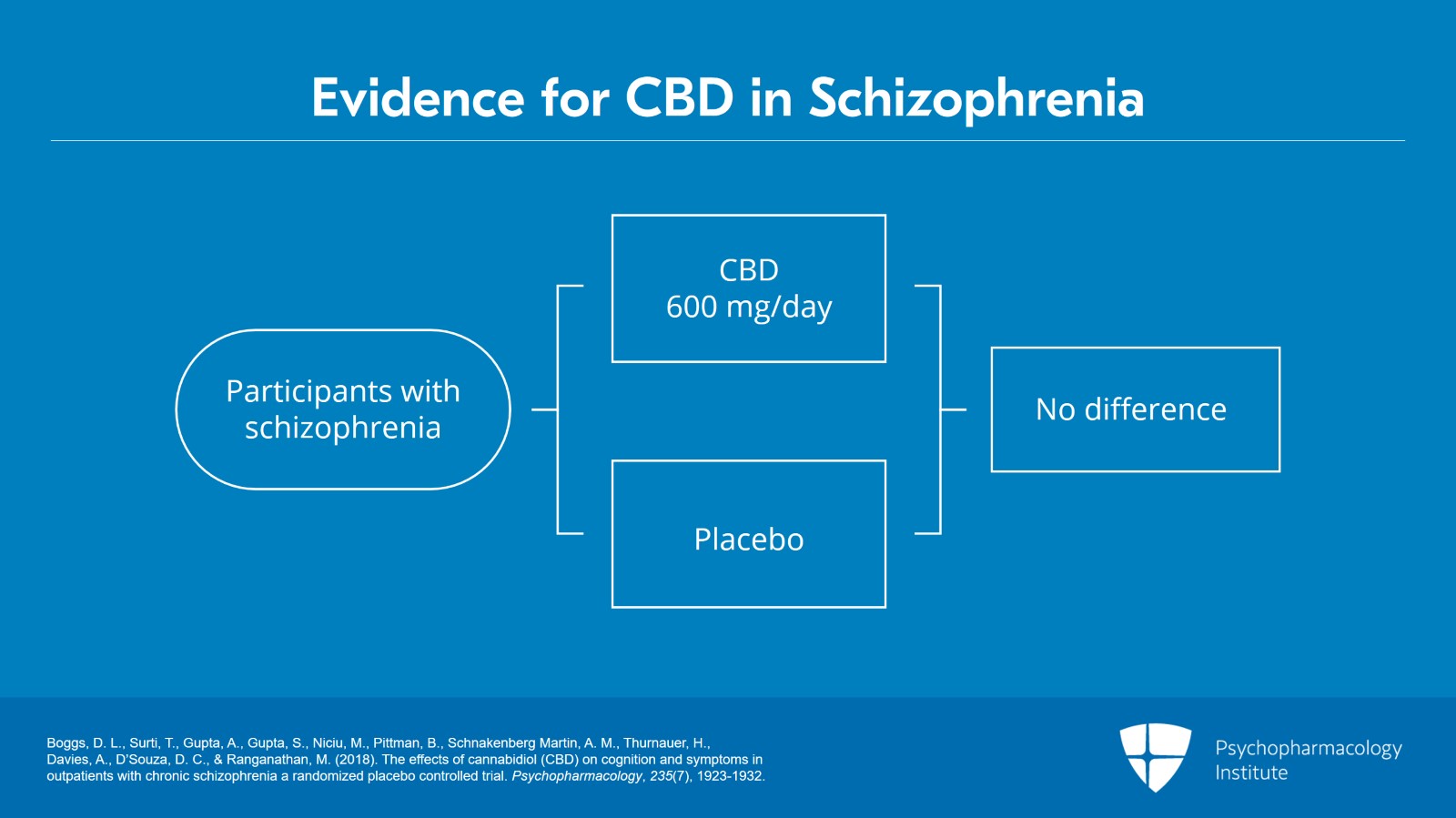
However, a third study compared CBD dosed at 600 mg a day to placebo and did not show a difference between these two groups.
References:
  • Boggs, D. L., Surti, T., Gupta, A., Gupta, S., Niciu, M., Pittman, B., Schnakenberg Martin, A. M., Thurnauer, H., Davies, A., D’Souza, D. C., & Ranganathan, M. (2018). The effects of cannabidiol (CBD) on cognition and symptoms in outpatients with chronic schizophrenia a randomized placebo controlled trial. Psychopharmacology, 235(7), 1923-1932.

Slide 8 of 16

Thus, the data in schizophrenia is mixed with some promising findings but with modest effects and needs replication.
References:
  • Boggs, D. L., Surti, T., Gupta, A., Gupta, S., Niciu, M., Pittman, B., Schnakenberg Martin, A. M., Thurnauer, H., Davies, A., D’Souza, D. C., & Ranganathan, M. (2018). The effects of cannabidiol (CBD) on cognition and symptoms in outpatients with chronic schizophrenia a randomized placebo controlled trial. Psychopharmacology, 235(7), 1923-1932.
  • McGuire, P., Robson, P., Cubala, W. J., Vasile, D., Morrison, P. D., Barron, R., Taylor, A., & Wright, S. (2018). Cannabidiol (CBD) as an adjunctive therapy in schizophrenia: A multicenter randomized controlled trial. American Journal of Psychiatry, 175(3), 225-231.
Free Files
Success!
Check your inbox, we sent you all the materials there.
Slide 9 of 16

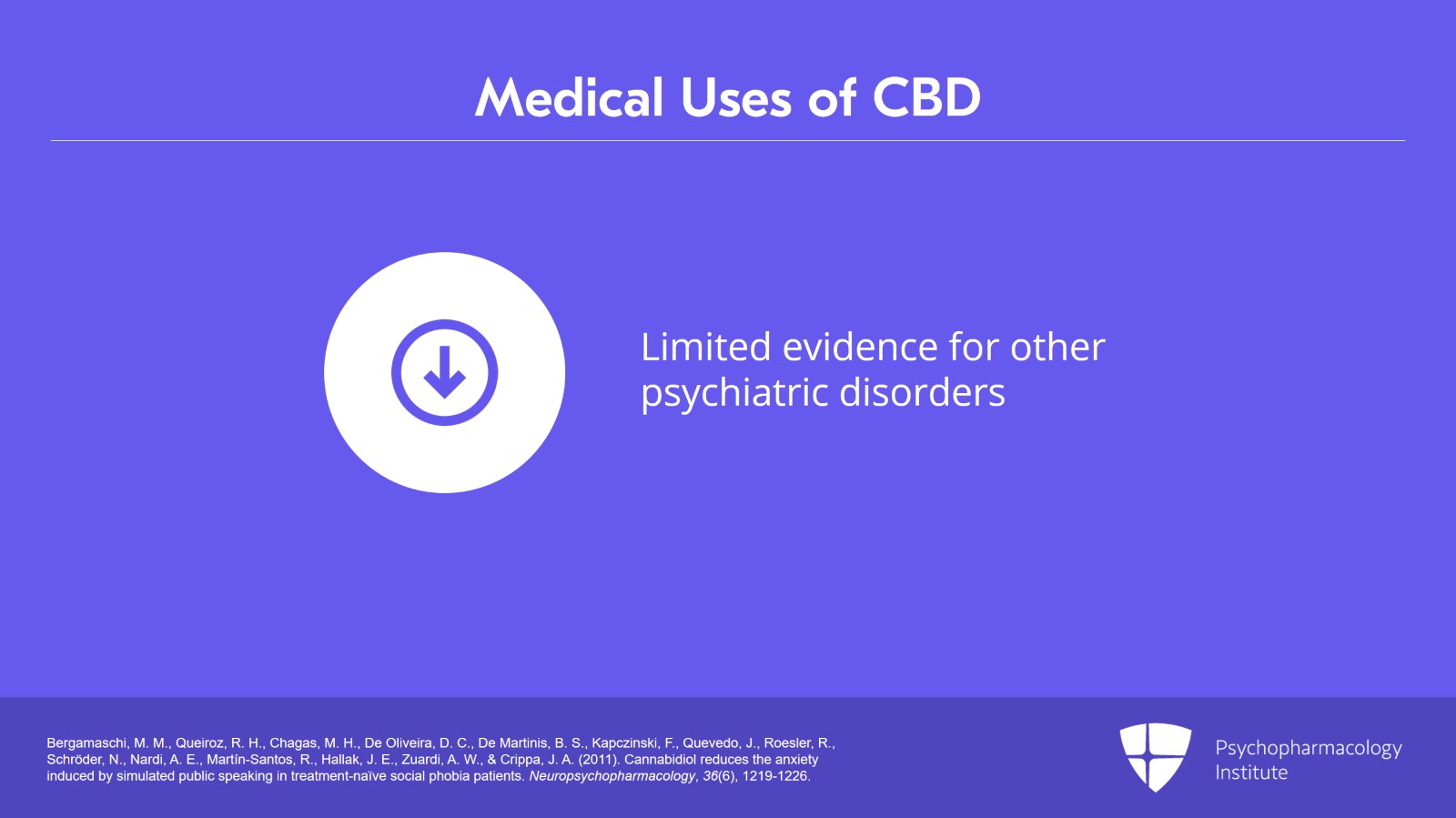
There’s also limited evidence looking at CBD for the treatment of other psychiatric disorders.
References:
  • Bergamaschi, M. M., Queiroz, R. H., Chagas, M. H., De Oliveira, D. C., De Martinis, B. S., Kapczinski, F., Quevedo, J., Roesler, R., Schröder, N., Nardi, A. E., Martín-Santos, R., Hallak, J. E., Zuardi, A. W., & Crippa, J. A. (2011). Cannabidiol reduces the anxiety induced by simulated public speaking in treatment-naïve social phobia patients. Neuropsychopharmacology, 36(6), 1219-1226.

Slide 10 of 16

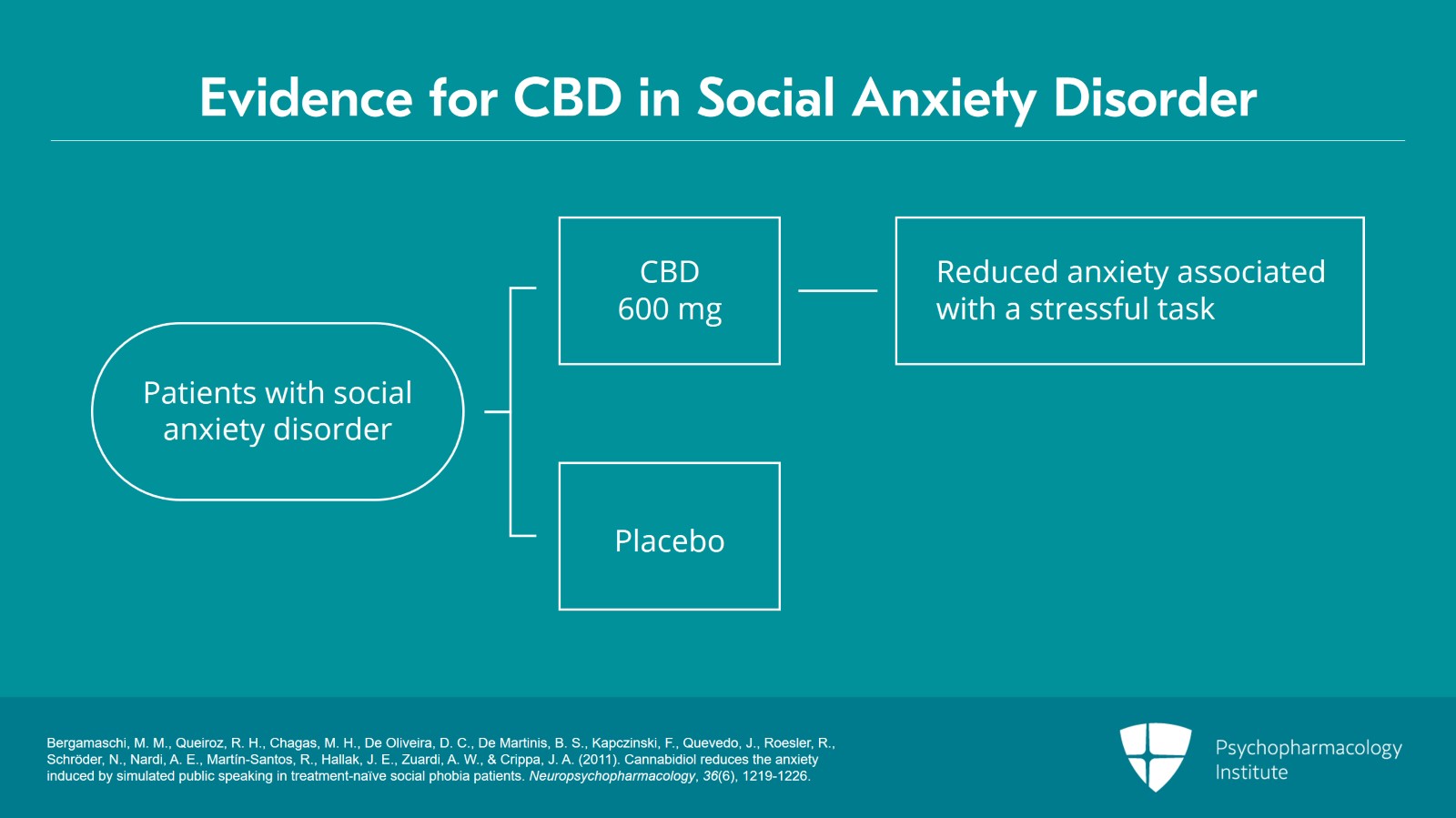
I’ll begin with social anxiety disorder. A small study was performed in social anxiety disorder with CBD dosed at 600 mg compared to placebo. The results showed that CBD reduced the anxiety associated with a stressful task which was public speaking in this study. So this indicates that CBD might be helpful with a social anxiety disorder but a larger study with regular dosing is needed.
References:
  • Bergamaschi, M. M., Queiroz, R. H., Chagas, M. H., De Oliveira, D. C., De Martinis, B. S., Kapczinski, F., Quevedo, J., Roesler, R., Schröder, N., Nardi, A. E., Martín-Santos, R., Hallak, J. E., Zuardi, A. W., & Crippa, J. A. (2011). Cannabidiol reduces the anxiety induced by simulated public speaking in treatment-naïve social phobia patients. Neuropsychopharmacology, 36(6), 1219-1226.
Free Files
Success!
Check your inbox, we sent you all the materials there.
Slide 11 of 16

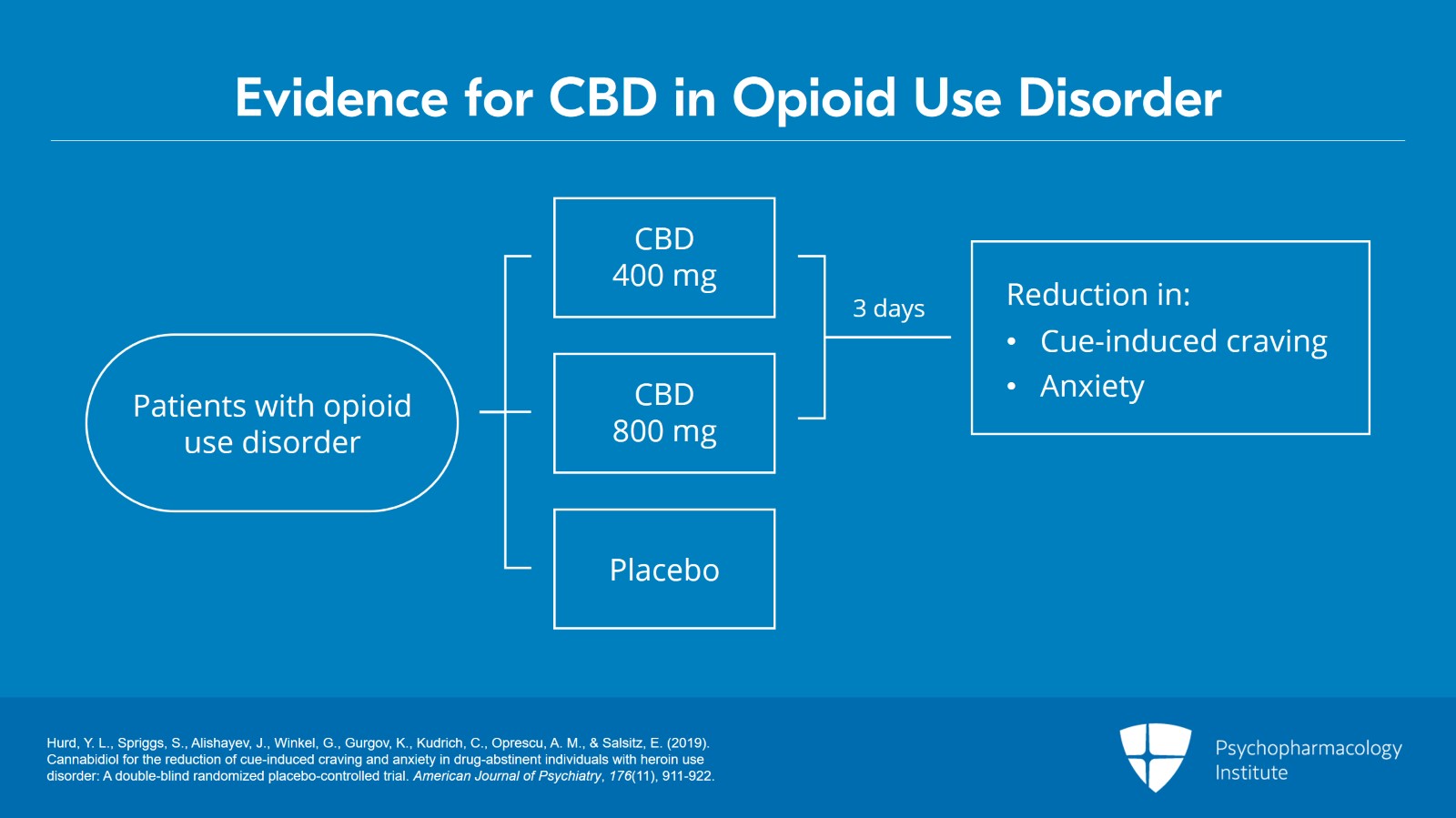
When it comes to opioid use disorder, there was one study that was done testing two doses of CBD, 400 and 800 mg, given for three days. The results showed that there was a reduction in cue-induced craving for heroin and a reduction in anxiety compared to placebo.
References:
  • Hurd, Y. L., Spriggs, S., Alishayev, J., Winkel, G., Gurgov, K., Kudrich, C., Oprescu, A. M., & Salsitz, E. (2019). Cannabidiol for the reduction of cue-induced craving and anxiety in drug-abstinent individuals with heroin use disorder: A double-blind randomized placebo-controlled trial. American Journal of Psychiatry, 176(11), 911-922.

Slide 12 of 16

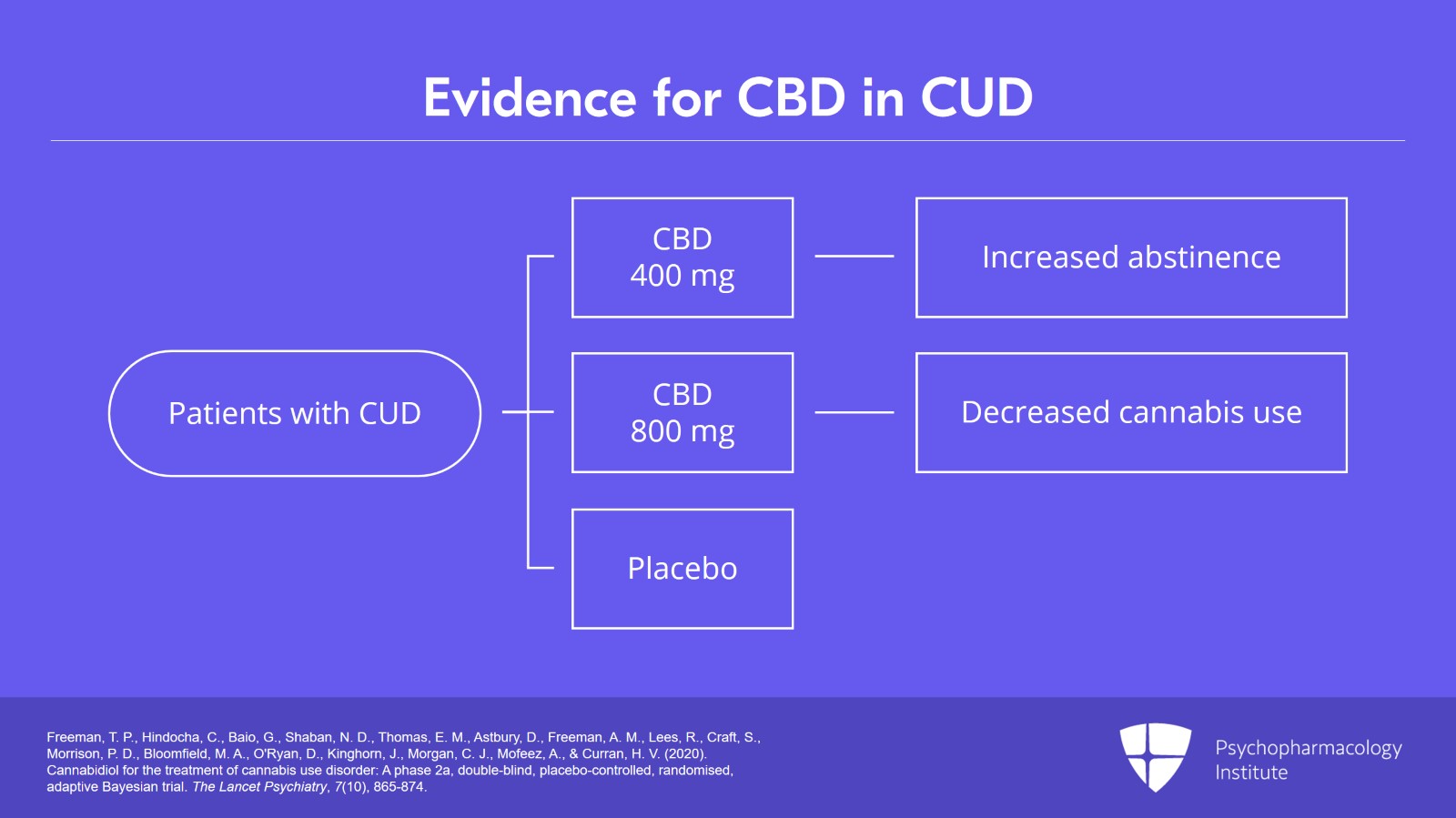
CBD has also been tested for cannabis use disorder. And a study looked at CBD versus placebo as a treatment for cannabis use disorder. The results showed that CBD dosed at 400 mg increased abstinence from cannabis by 0.48 days per week and that a CBD dose of 800 mg decreased cannabis use by 0.27 days per week compared to placebo.
References:
  • Freeman, T. P., Hindocha, C., Baio, G., Shaban, N. D., Thomas, E. M., Astbury, D., Freeman, A. M., Lees, R., Craft, S., Morrison, P. D., Bloomfield, M. A., O'Ryan, D., Kinghorn, J., Morgan, C. J., Mofeez, A., & Curran, H. V. (2020). Cannabidiol for the treatment of cannabis use disorder: A phase 2a, double-blind, placebo-controlled, randomised, adaptive Bayesian trial. The Lancet Psychiatry, 7(10), 865-874.
Free Files
Success!
Check your inbox, we sent you all the materials there.
Slide 13 of 16

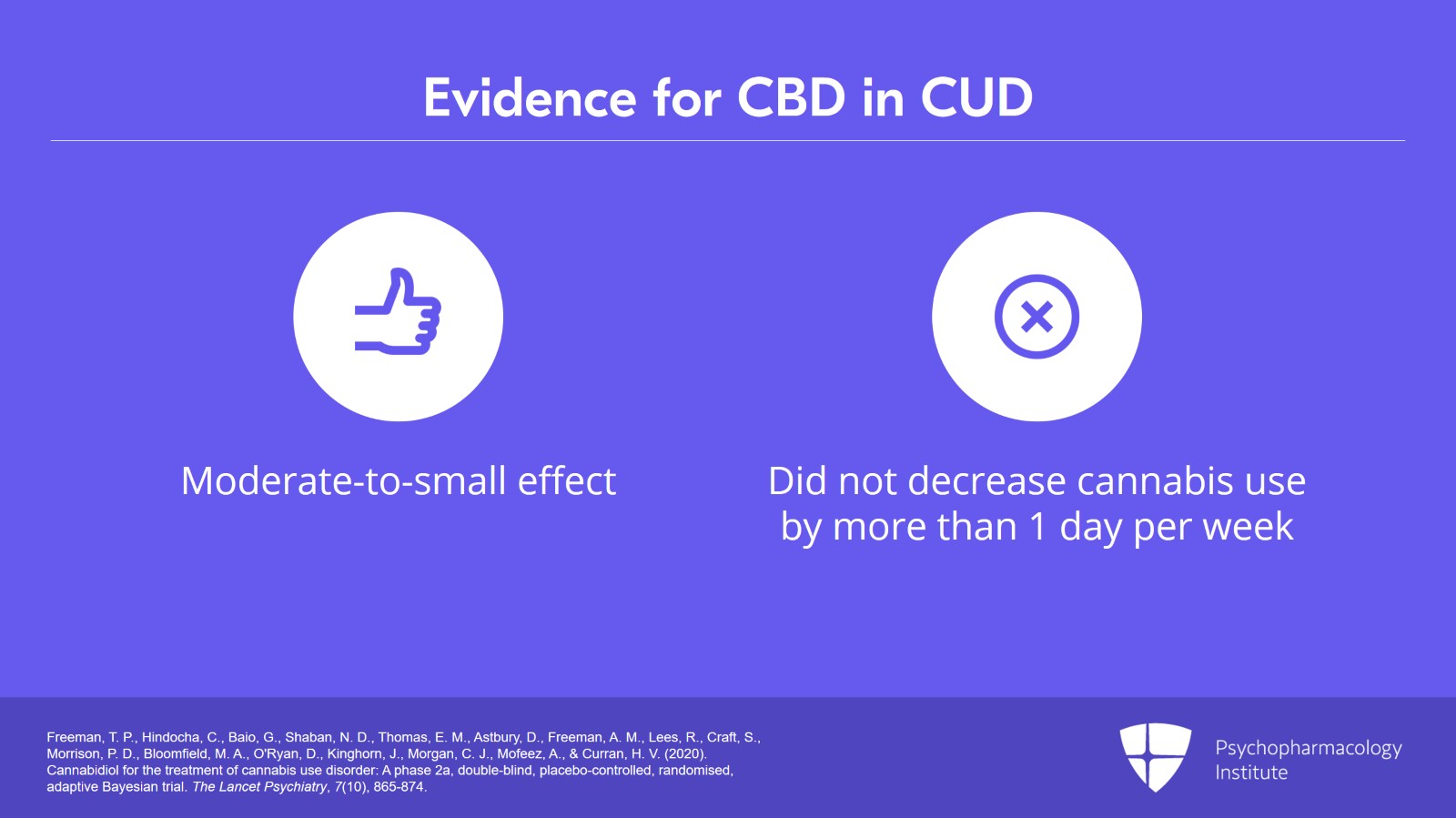
In other words, CBD did have a significant effect but this effect was relatively moderate to small and did not decrease cannabis use by more than one day per week.
References:
  • Freeman, T. P., Hindocha, C., Baio, G., Shaban, N. D., Thomas, E. M., Astbury, D., Freeman, A. M., Lees, R., Craft, S., Morrison, P. D., Bloomfield, M. A., O'Ryan, D., Kinghorn, J., Morgan, C. J., Mofeez, A., & Curran, H. V. (2020). Cannabidiol for the treatment of cannabis use disorder: A phase 2a, double-blind, placebo-controlled, randomised, adaptive Bayesian trial. The Lancet Psychiatry, 7(10), 865-874.

Slide 14 of 16

I’ll review the key points here. The strongest evidence for CBD is reducing seizures in childhood epilepsy. CBD might help with symptoms of schizophrenia especially the positive symptoms of psychosis.
Free Files
Success!
Check your inbox, we sent you all the materials there.
Slide 15 of 16

There is some evidence that CBD may be helpful for social anxiety disorder, opioid use disorder, and cannabis use disorder. However, there is a need to replicate these studies and to look at potential effects in much larger studies.

Slide 16 of 16

Free Files
Success!
Check your inbox, we sent you all the materials there.
Learning Objectives:

After completing this activity, the learner will be able to:

  1. Discuss the impact of cannabis use on psychiatric symptoms and cognition.
  2. Evaluate current evidence available regarding the use of cannabis for medical and psychiatric disorders.
  3. Identify the differences between various types of cannabinoids in terms of clinical use and risk profiles.

Original Release Date: 10/01/2021

Review and Re-release Date: 03/01/2024

Expiration Date: 04/01/2025

Expert: Diana Martinez, M.D.

Medical Editor: Melissa Mariano, M.D

Relevant Financial Disclosures:

None of the faculty, planners, and reviewers for this educational activity have relevant financial relationship(s) to disclose during the last 24 months with ineligible companies whose primary business is producing, marketing, selling, re-selling, or distributing healthcare products used by or on patients.

Contact Information: For questions regarding the content or access to this activity, contact us at support@psychopharmacologyinstitute.com

Instructions for Participation and Credit:

Participants must complete the activity online during the valid credit period that is noted above.

Follow these steps to earn CME credit:

  1. View the required educational content provided on this course page.
  2. Complete the Post Activity Evaluation for providing the necessary feedback for continuing accreditation purposes and for the development of future activities. NOTE: Completing the Post Activity Evaluation after the quiz is required to receive the earned credit.
  3. Download your certificate.

Accreditation Statement

This activity has been planned and implemented in accordance with the accreditation requirements and policies of the Accreditation Council for Continuing Medical Education through the joint providership of Medical Academy LLC and the Psychopharmacology Institute. Medical Academy is accredited by the ACCME to provide continuing medical education for physicians.

Credit Designation Statement

Medical Academy designates this enduring activity for a maximum of 0.75 AMA PRA Category 1 credit(s). Physicians should claim only the credit commensurate with the extent of their participation in the activity.

Free Files
Success!
Check your inbox, we sent you all the materials there.
Continue in the website
Instant access modal

Become a Bronze, Silver, Gold, Bronze extended, Silver extended or Gold extended Member.

2025–26 Psychopharmacology CME Program

Unlock up to 155 CME Credits, including 40 SA CME Credits.