Close Banner
Section Free  - Video Lectures

03. Cannabis and Cognition

Published on October 1, 2021 Expired on April 1, 2025

Diana Martinez, M.D.

Professor of Psychiatry - Columbia University Irving Medical Center

Key Points

  • Cannabis can be associated with acute cognitive changes.
  • Acute cannabis intoxication results in impaired concentration, impaired attention, impulsivity, and decreases in working memory.
  • In adults, most of the effects wear off with abstinence.
  • Impulsivity and long-term impairment in decision making is seen in heavy cannabis users.
  • In adolescents, cannabis use is more closely associated with cognitive problems.
  • Cannabis use should be avoided in younger people.

Free Downloads for Offline Access

  • Free Download Presentation File (PPTX)
  • Free Download Audio File (MP3)
  • Free Download Video (MP4)

Slides and Transcript

Slide 1 of 13

Video 3: Cannabis and Cognition. Now, we'll ask the question, does cannabis use cause cognitive deficits?

Slide 2 of 13

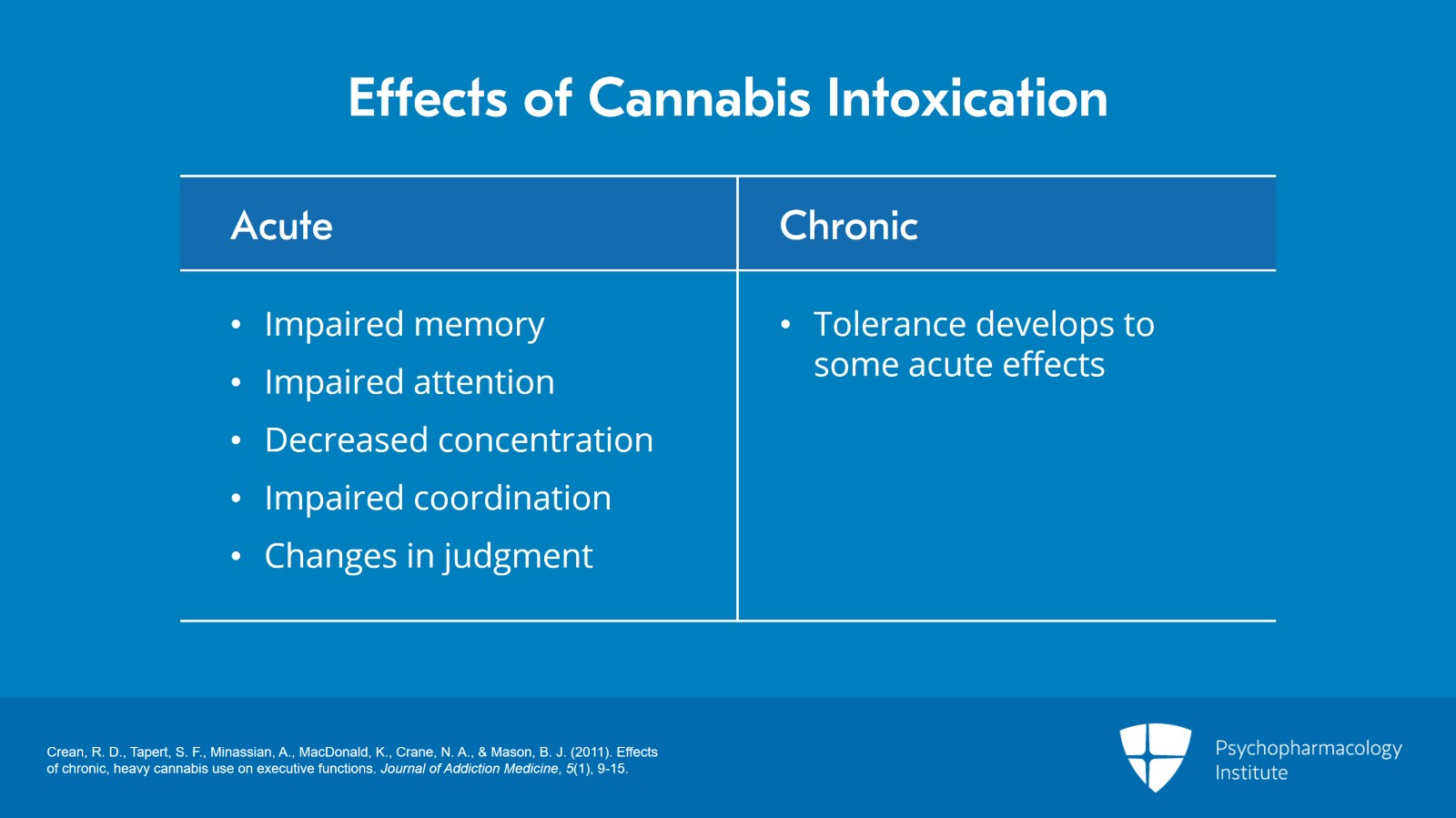
Certainly, acute cannabis intoxication is associated with impaired memory, impaired attention, decreases in concentration, impaired coordination, and changes in judgment. Studies have shown that chronic cannabis users can develop tolerance to some of these acute effects of intoxication.
References:
  • Crean, R. D., Tapert, S. F., Minassian, A., MacDonald, K., Crane, N. A., & Mason, B. J. (2011). Effects of chronic, heavy cannabis use on executive functions. Journal of Addiction Medicine, 5(1), 9-15.
Free Files
Success!
Check your inbox, we sent you all the materials there.

Slide 3 of 13

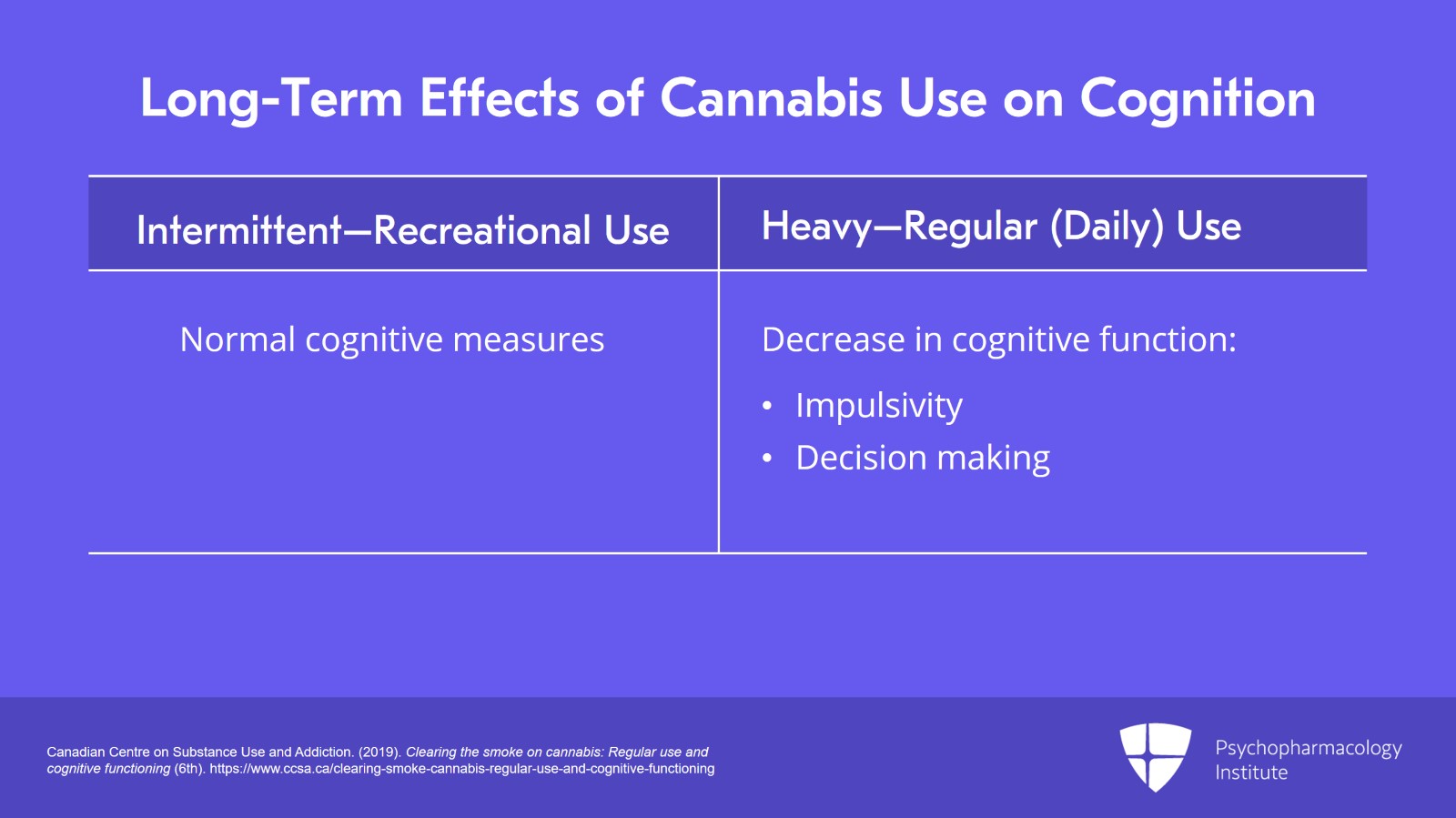
But now we want to ask the question, are there long-term effects on cognition that come with cannabis use? Research studies have investigated whether cannabis use is associated with effects on cognition that persist after the acute intoxicating effects of THC have subsided. Overall, these studies show that in adults who use cannabis recreationally, cognitive measures like verbal fluency, attention and concentration are normal. However, heavy, regular or daily cannabis use is associated with a decrease in cognitive function when it comes to impulsivity and decision making.
References:
  • Canadian Centre on Substance Use and Addiction. (2019). Clearing the smoke on cannabis: Regular use and cognitive functioning (6th). https://www.ccsa.ca/clearing-smoke-cannabis-regular-use-and-cognitive-functioning

Slide 4 of 13

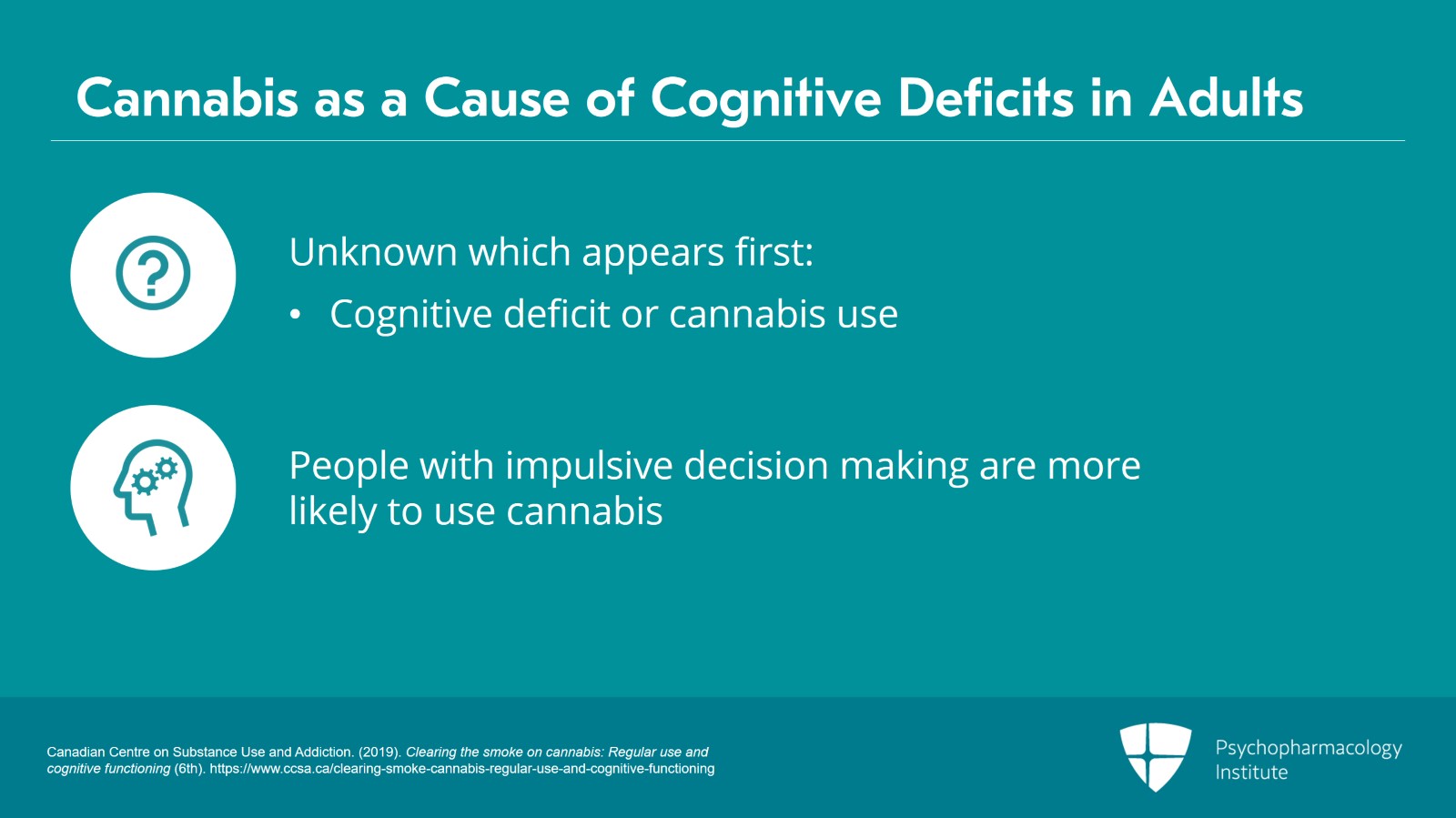
Nonetheless, we can't say that cannabis causes cognitive deficits in adults. It's not known which came first, the cognitive deficit or the cannabis use. It's possible that people with impulsive decision making are more likely to be using cannabis heavily and regularly as adults.
References:
  • Canadian Centre on Substance Use and Addiction. (2019). Clearing the smoke on cannabis: Regular use and cognitive functioning (6th). https://www.ccsa.ca/clearing-smoke-cannabis-regular-use-and-cognitive-functioning
Free Files
Success!
Check your inbox, we sent you all the materials there.

Slide 5 of 13

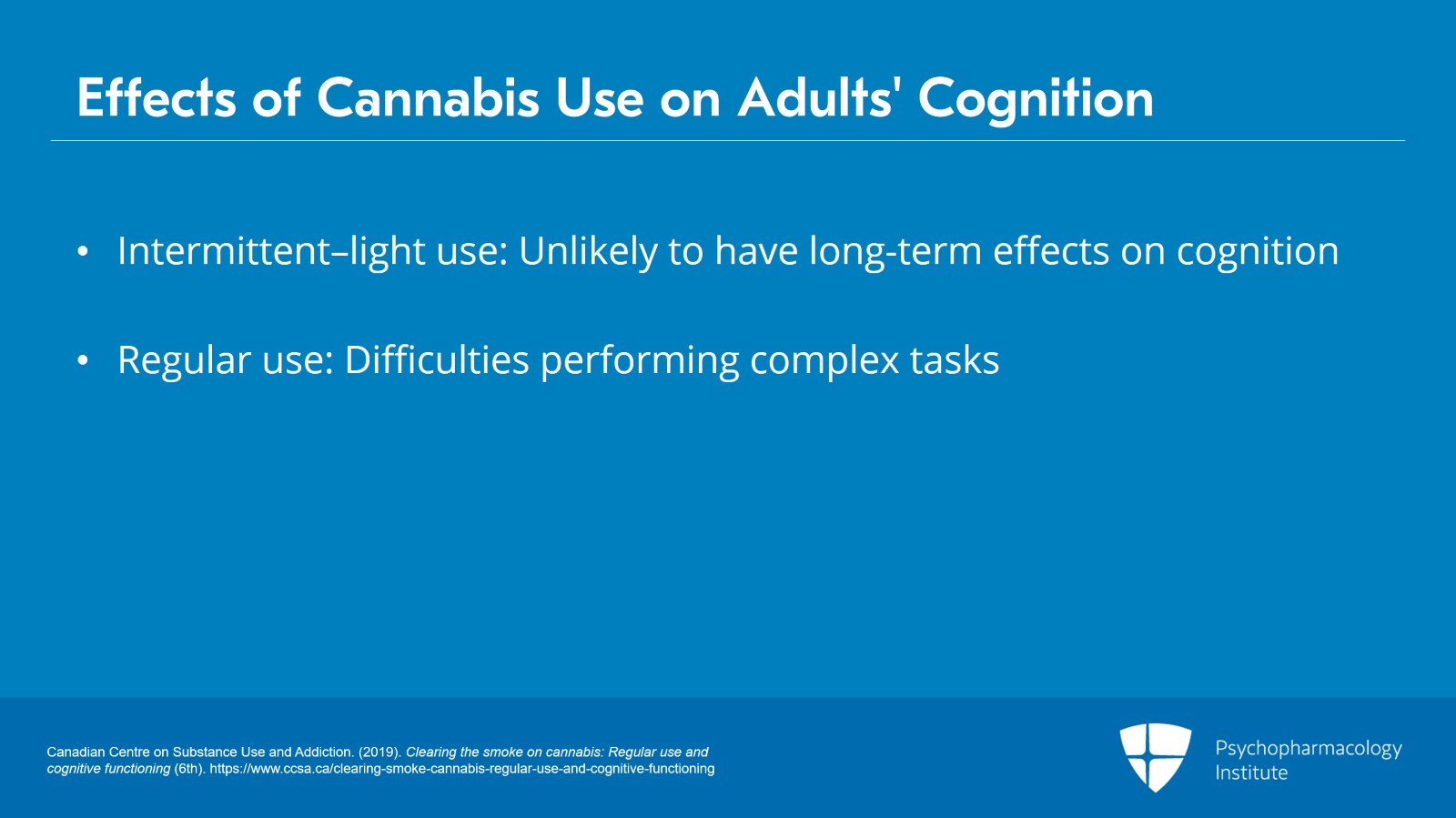
What advice can we give to our patients? We know that intermittent light cannabis use is not likely to have serious long-term effects on cognition. Those who use cannabis regularly are likely to perform reasonably well on routine everyday life tasks, but they might encounter difficulties when performing complex tasks that are novel, require learning or rely heavily on memory.
References:
  • Canadian Centre on Substance Use and Addiction. (2019). Clearing the smoke on cannabis: Regular use and cognitive functioning (6th). https://www.ccsa.ca/clearing-smoke-cannabis-regular-use-and-cognitive-functioning

Slide 6 of 13

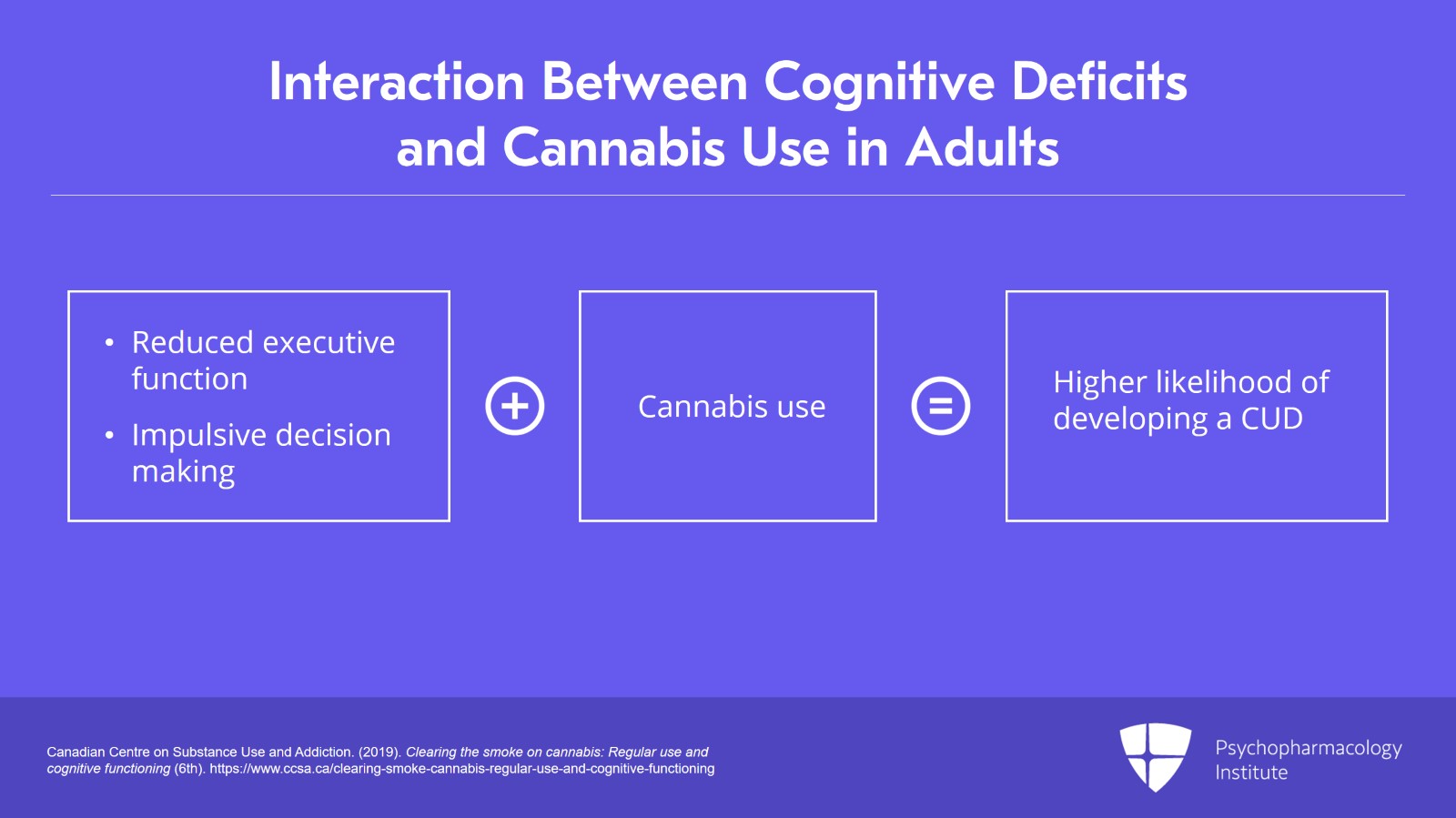
It's also key to recognize that the interaction of reduced executive function or impulsive decision making in cannabis use has a higher likelihood of leading to a cannabis use disorder.
References:
  • Canadian Centre on Substance Use and Addiction. (2019). Clearing the smoke on cannabis: Regular use and cognitive functioning (6th). https://www.ccsa.ca/clearing-smoke-cannabis-regular-use-and-cognitive-functioning
Free Files
Success!
Check your inbox, we sent you all the materials there.

Slide 7 of 13

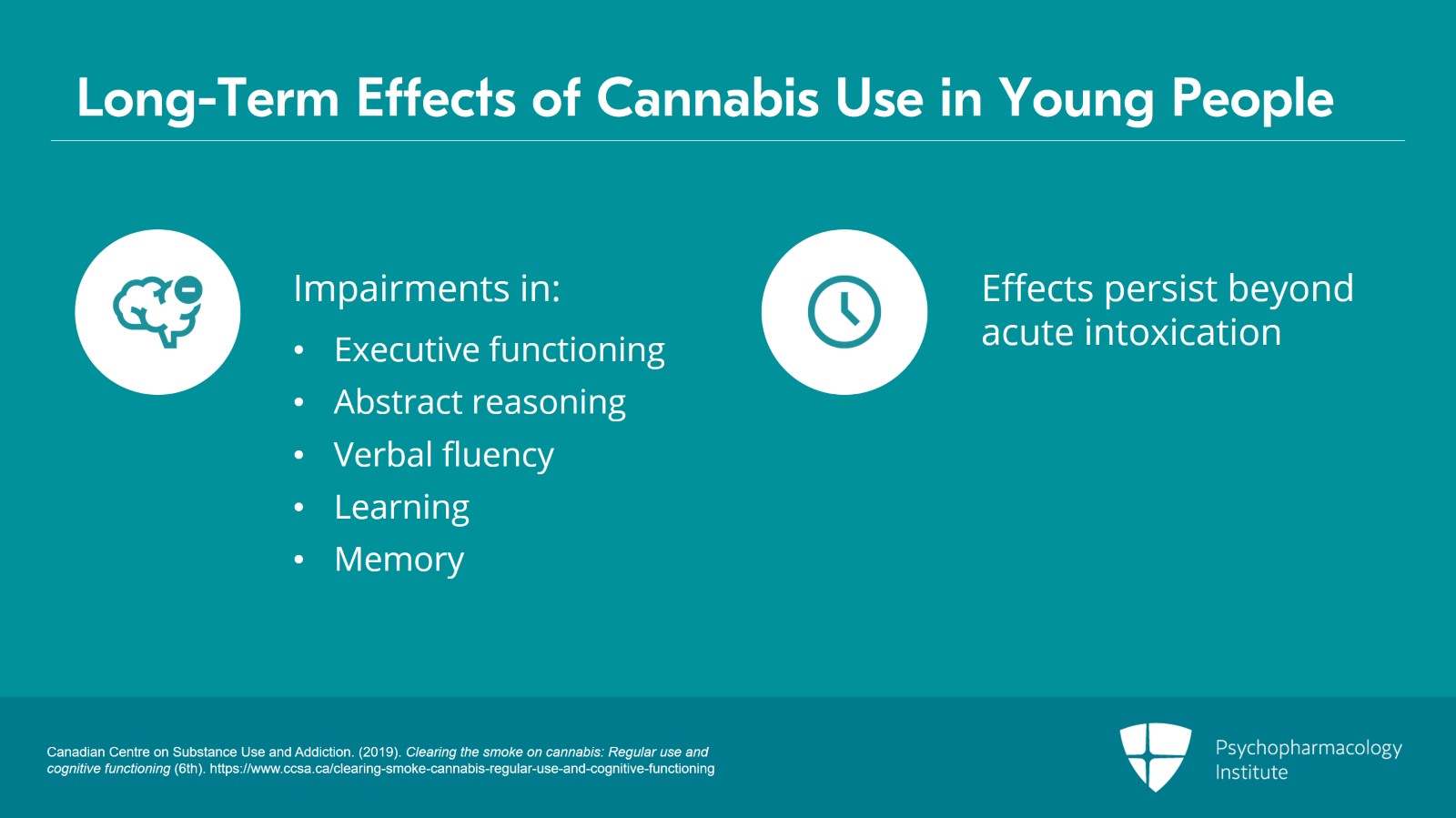
Now, I'll move on to cannabis and cognition in children. In young people, cannabis use may have long-term effects. Some studies show that cannabis use in individuals under the age of 17 is associated with impairments in executive functioning, abstract reasoning, verbal fluency, learning and memory, and that these effects persist beyond acute intoxication.
References:
  • Canadian Centre on Substance Use and Addiction. (2019). Clearing the smoke on cannabis: Regular use and cognitive functioning (6th). https://www.ccsa.ca/clearing-smoke-cannabis-regular-use-and-cognitive-functioning

Slide 8 of 13

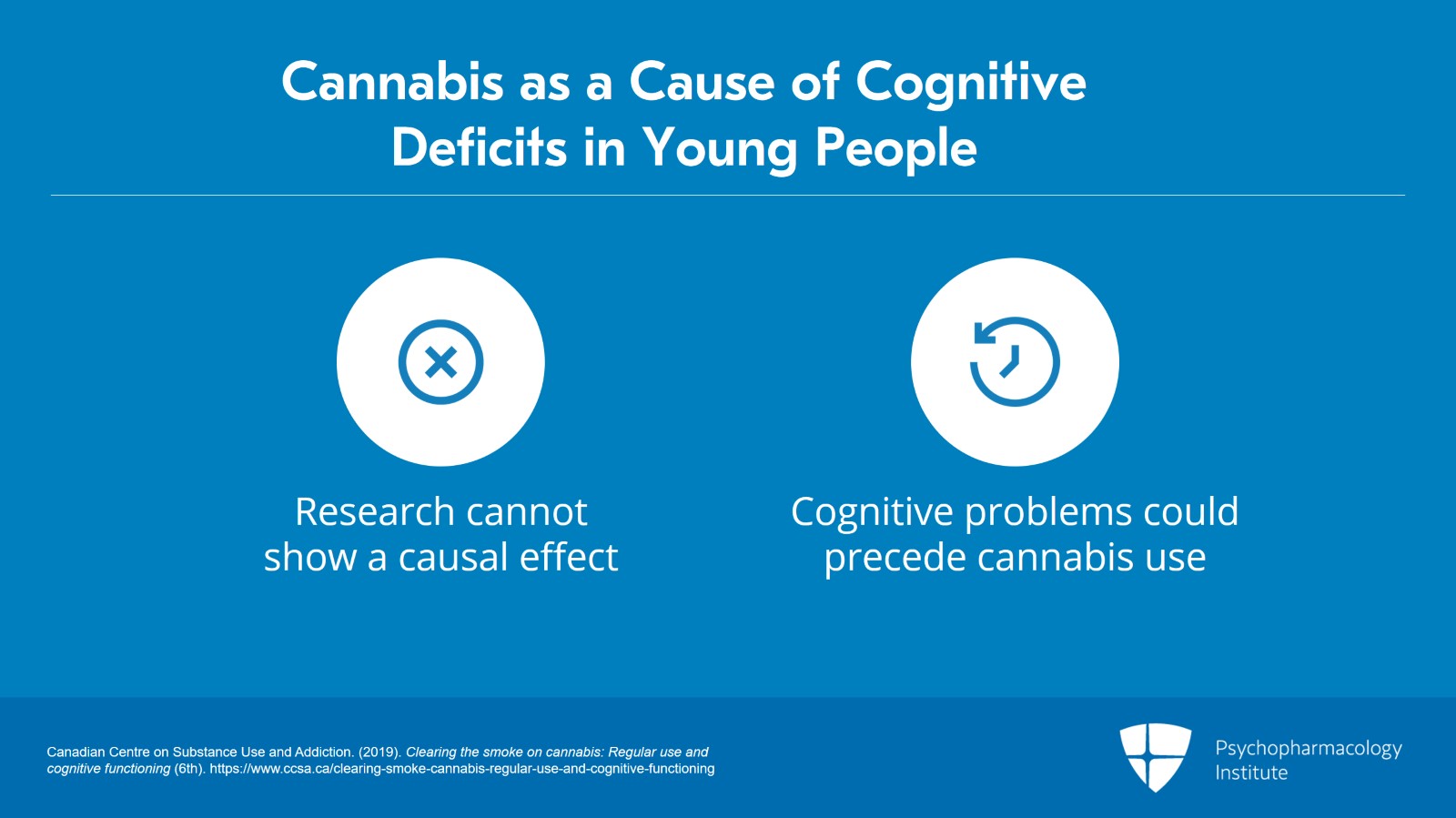
However, this research again cannot show a causal effect. We don't know if cannabis is causing the cognitive deficits since it's possible that the cognitive issues preceded cannabis use.
References:
  • Canadian Centre on Substance Use and Addiction. (2019). Clearing the smoke on cannabis: Regular use and cognitive functioning (6th). https://www.ccsa.ca/clearing-smoke-cannabis-regular-use-and-cognitive-functioning
Free Files
Success!
Check your inbox, we sent you all the materials there.

Slide 9 of 13

Given that the human brain, especially the prefrontal cortex, continues to develop and prune until about age 25, cannabis use in young people should be considered high risk. When it comes to the developing brain less exposure to cannabis is certainly better, and this applies to all drugs. As little drug exposure for as long as possible is the best approach.
References:
  • Canadian Centre on Substance Use and Addiction. (2019). Clearing the smoke on cannabis: Regular use and cognitive functioning (6th). https://www.ccsa.ca/clearing-smoke-cannabis-regular-use-and-cognitive-functioning

Slide 10 of 13

So, the key point here is that cannabis can be associated with acute cognitive changes. Acute intoxication results in impaired concentration, impaired attention, impulsivity, and decreases in working memory.
Free Files
Success!
Check your inbox, we sent you all the materials there.

Slide 11 of 13

In adults, most of these effects will wear off with abstinence. However, impulsivity and long-term impairment in decision making is seen in heavy cannabis users. 

Slide 12 of 13

In adolescents, cannabis use is more closely associated with cognitive problems. Cannabis use is best avoided in this age group.
Free Files
Success!
Check your inbox, we sent you all the materials there.

Slide 13 of 13

Learning Objectives:

After completing this activity, the learner will be able to:

  1. Discuss the impact of cannabis use on psychiatric symptoms and cognition.
  2. Evaluate current evidence available regarding the use of cannabis for medical and psychiatric disorders.
  3. Identify the differences between various types of cannabinoids in terms of clinical use and risk profiles.

Original Release Date: 10/01/2021

Review and Re-release Date: 03/01/2024

Expiration Date: 04/01/2025

Expert: Diana Martinez, M.D.

Medical Editor: Melissa Mariano, M.D

Relevant Financial Disclosures:

None of the faculty, planners, and reviewers for this educational activity have relevant financial relationship(s) to disclose during the last 24 months with ineligible companies whose primary business is producing, marketing, selling, re-selling, or distributing healthcare products used by or on patients.

Contact Information: For questions regarding the content or access to this activity, contact us at support@psychopharmacologyinstitute.com

Instructions for Participation and Credit:

Participants must complete the activity online during the valid credit period that is noted above.

Follow these steps to earn CME credit:

  1. View the required educational content provided on this course page.
  2. Complete the Post Activity Evaluation for providing the necessary feedback for continuing accreditation purposes and for the development of future activities. NOTE: Completing the Post Activity Evaluation after the quiz is required to receive the earned credit.
  3. Download your certificate.

Accreditation Statement

This activity has been planned and implemented in accordance with the accreditation requirements and policies of the Accreditation Council for Continuing Medical Education through the joint providership of Medical Academy LLC and the Psychopharmacology Institute. Medical Academy is accredited by the ACCME to provide continuing medical education for physicians.

Credit Designation Statement

Medical Academy designates this enduring activity for a maximum of 0.75 AMA PRA Category 1 credit(s). Physicians should claim only the credit commensurate with the extent of their participation in the activity.


Free Files
Success!
Check your inbox, we sent you all the materials there.
Continue in the website
Instant access modal

Become a Bronze, Silver, Gold, Bronze extended, Silver extended or Gold extended Member.

2025–26 Psychopharmacology CME Program

Unlock up to 155 CME Credits, including 40 SA CME Credits.