


Slides and Transcript
Slide 1 of 7
Now, we’re going to review a diagnostic and treatment algorithm for OCD that we developed at the University of Pittsburgh. And this algorithm goes over the steps that you should take after diagnosis of OCD and what type of treatment that you should do.
Slide 2 of 7
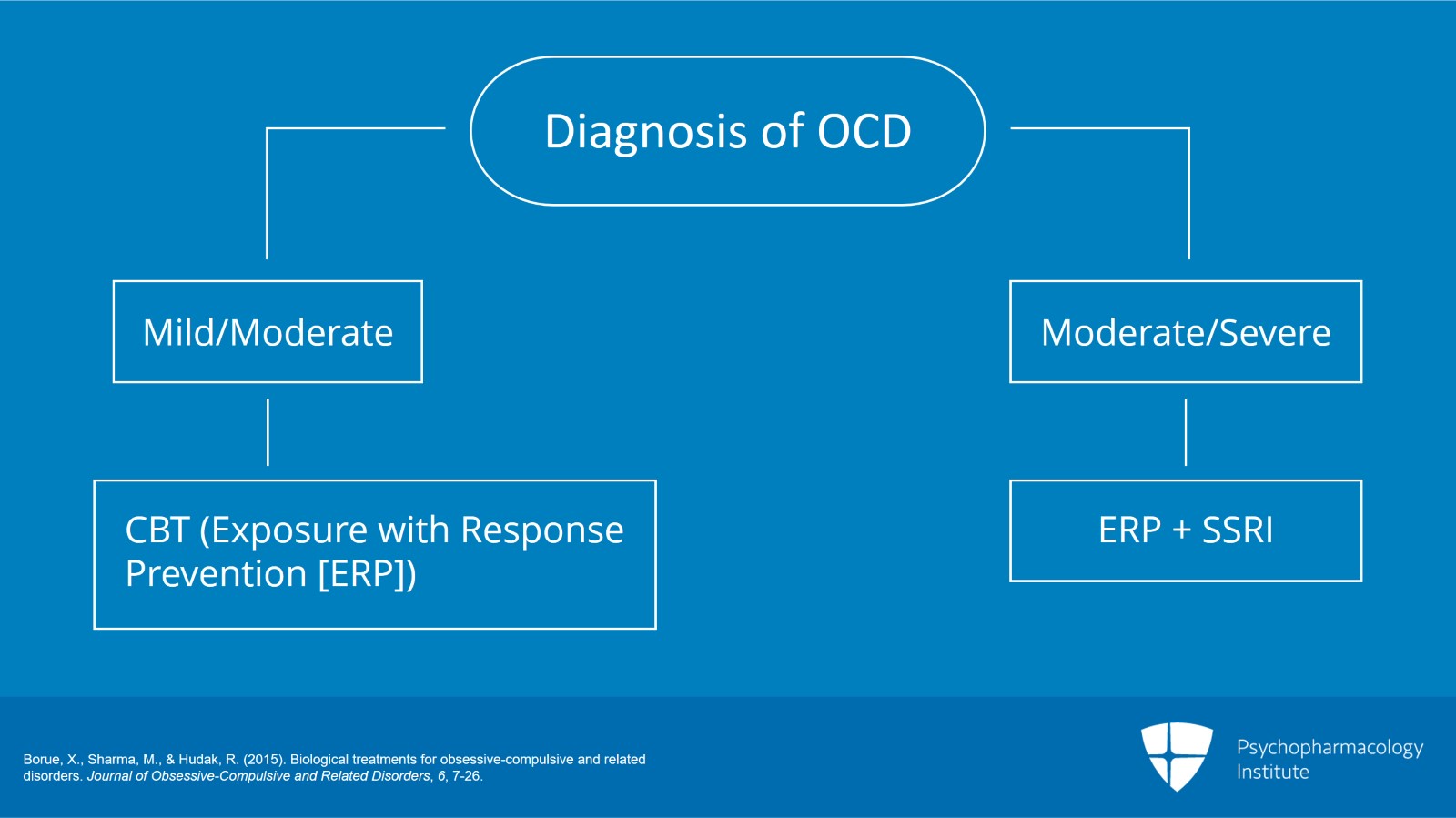
So first off, of course, you have to make the diagnosis of OCD. We talked about that in the previous video. The next step here in the treatment algorithm is very important. Mild to moderate OCD. Patients can be offered CBT particularly a specific type of CBT that we call ERP which stands for exposure with response prevention. And this should be offered to people with mild to moderate OCD. People with moderate to severe OCD can be offered exposure with response prevention and also be given an SSRI.
The key point with this slide and this first part of the slide is that at no time is an appropriate treatment plan for a patient to be told that they can be placed on medication only without behavioral therapy. Behavioral therapy is really key in OCD. At worst case scenario, behavioral therapy is shown to be the equivalent of efficacy of medications. And in many papers in many instances, ERP has been shown to be more helpful than medications.
One difficulty with this is that appropriate ERP is very difficult to find. Most therapists are not trained in ERP and there are a very few graduate schools in the United States that teach ERP on a regular basis. There are numerous people out there who will say that they can do what they call “exposure therapy” but they’re not doing ERP. Typically, what therapists are calling exposure therapy is really something called systematic desensitization that is very different than ERP and can actually be used as placebo when you’re doing therapy studies.
The key for exposure with response prevention therapy is not just the exposure but the ritual prevention. Most of the therapies that therapists are doing when they say they’re doing exposure therapy, they’re not doing the response prevention part. It takes some skill and some practice to learn how to do that. So again, any therapist that’s treating your patient, make sure they’re actually doing ERP and not just “exposure therapy.“
References:
- Borue, X., Sharma, M., & Hudak, R. (2015). Biological treatments for obsessive-compulsive and related disorders. Journal of Obsessive-Compulsive and Related Disorders, 6, 7-26.
Unlock this Video Lecture and earn 1.25 CMEs
Become a Bronze, Silver, Gold, Bronze extended, Silver extended or Gold extended Member.
Already have an account? Sign in
