Slides and Transcript
Slide 1 of 10
So our next section is going to turn toward medications that we use in older age bipolar disorder.
Slide 2 of 10
As I mentioned earlier, these are not drugs that are unique to older patients. Certainly, we use these medications in any age adults. But let’s talk about the specific points of concern with older people. Lithium is a drug that we tested in our GERI-BD study. I shared some of that data with you. Lithium is an effective drug for bipolar disorder. It is associated with some potential significant adverse effects including weight gain, GI disturbances, cognitive slowing, neurotoxic effects that could occur even with relatively minor overdose. It has a narrow therapeutic index. We have to monitor drug levels. And you can see some endocrine abnormalities like thyroid toxicity and diabetes insipidus.
References:
- Baldessarini, R. J. (2002). Treatment research in bipolar disorder. CNS drugs, 16(11), 721-729.
Free Files
Download PDF and other files
Success!
Check your inbox, we sent you all the materials there.
Slide 3 of 10
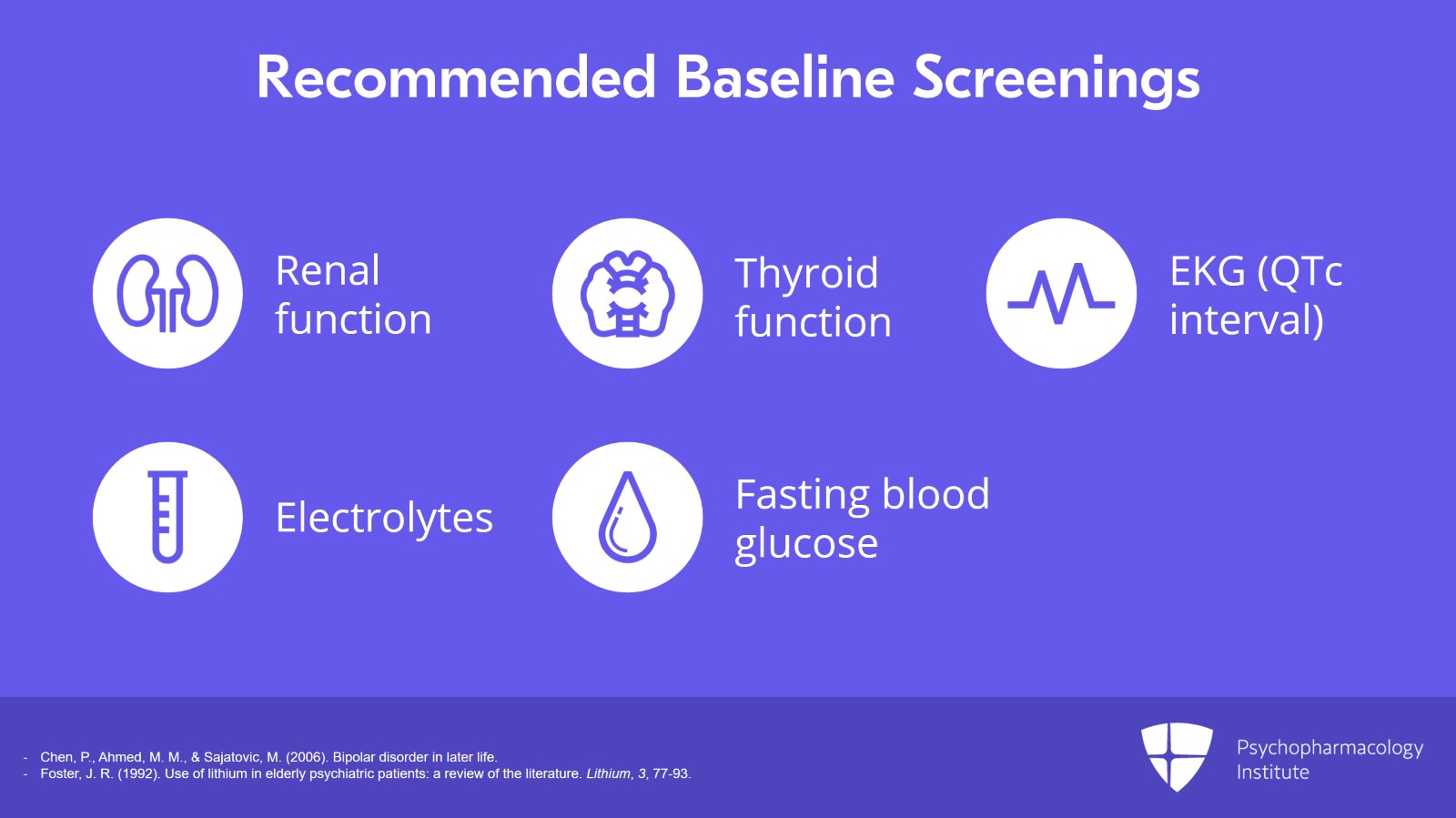
If we start lithium in older people, there are some recommended baseline screenings that one would want to have either to do before starting or within the recent past. One of the good things about working with older people with bipolar disorder is that they often are seeing their primary care or internist and they will have tests that would have been drawn in the recent past. Things like renal function, electrolytes, thyroid function, fasting blood glucose and EKG looking at QTc intervals or other relevant abnormalities will be good for me to know before I start lithium.
References:
- Chen, P., Ahmed, M. M., & Sajatovic, M. (2006). Bipolar disorder in later life.
- Foster, J. R. (1992). Use of lithium in elderly psychiatric patients: a review of the literature. Lithium, 3, 77-93.
Slide 4 of 10
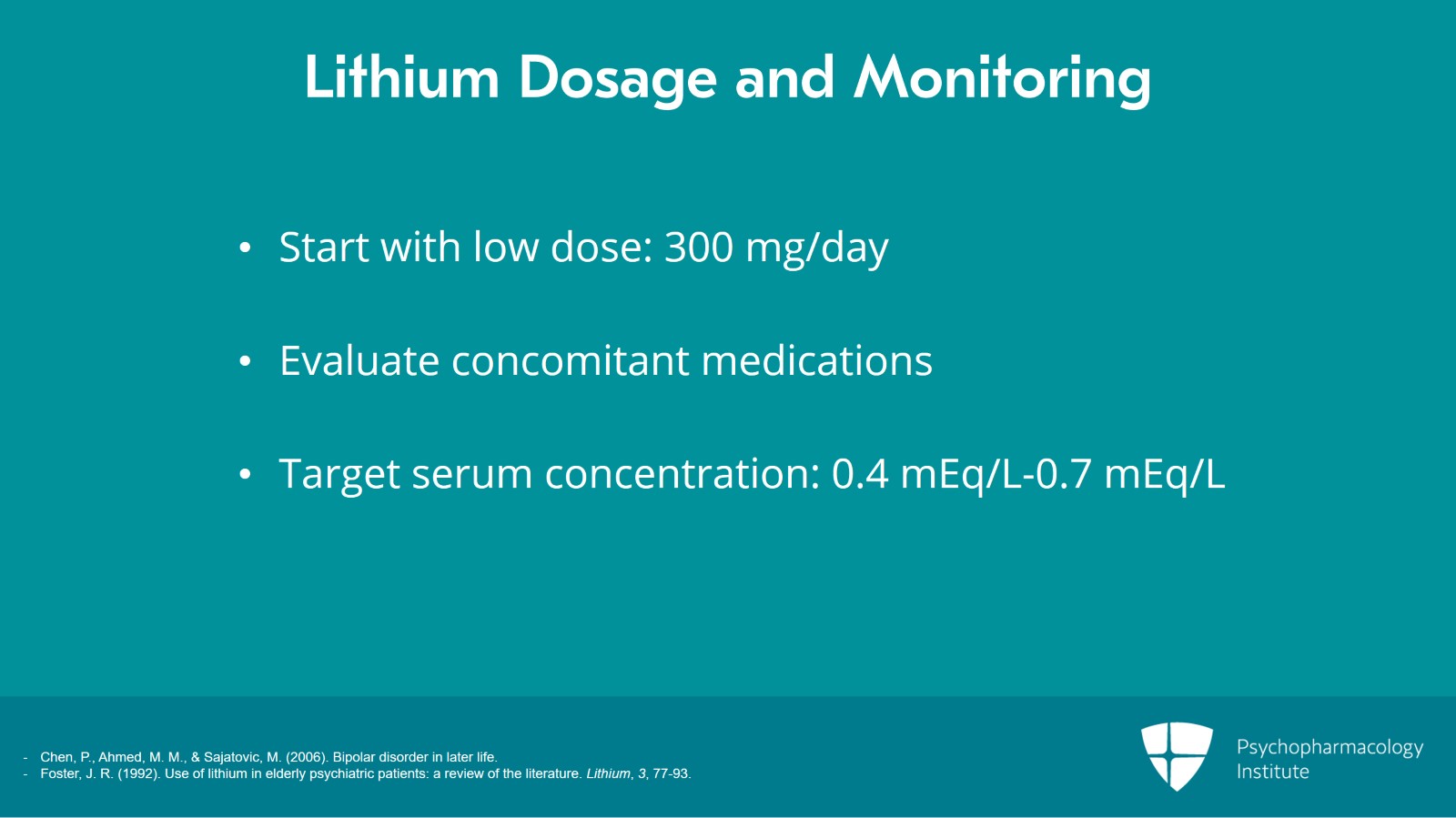
Then generally, we will start with a low dose, perhaps 300 mg per day. In the GERI-BD study, we started with 150 mg twice daily. Usual dose should not generally exceed 900 mg per day. However, that’s not a hard and fast rule. There are some healthy elderly that will and do need higher dosage
You’re going to want to evaluate concomitant medications especially those that can alter sodium excretion like the NSAIDs or diuretics.
Target serum concentration, so there is sort of the high and low school with serum concentrations. A good rule of thumb is that the older and more frail people are, one might tend to go toward that lower end of the swimming pool here that 0.4 to 0.7 mEq/L target range rather than the upper ones.
References:
- Chen, P., Ahmed, M. M., & Sajatovic, M. (2006). Bipolar disorder in later life.
- Foster, J. R. (1992). Use of lithium in elderly psychiatric patients: a review of the literature. Lithium, 3, 77-93.
Free Files
Download PDF and other files
Success!
Check your inbox, we sent you all the materials there.
Slide 5 of 10
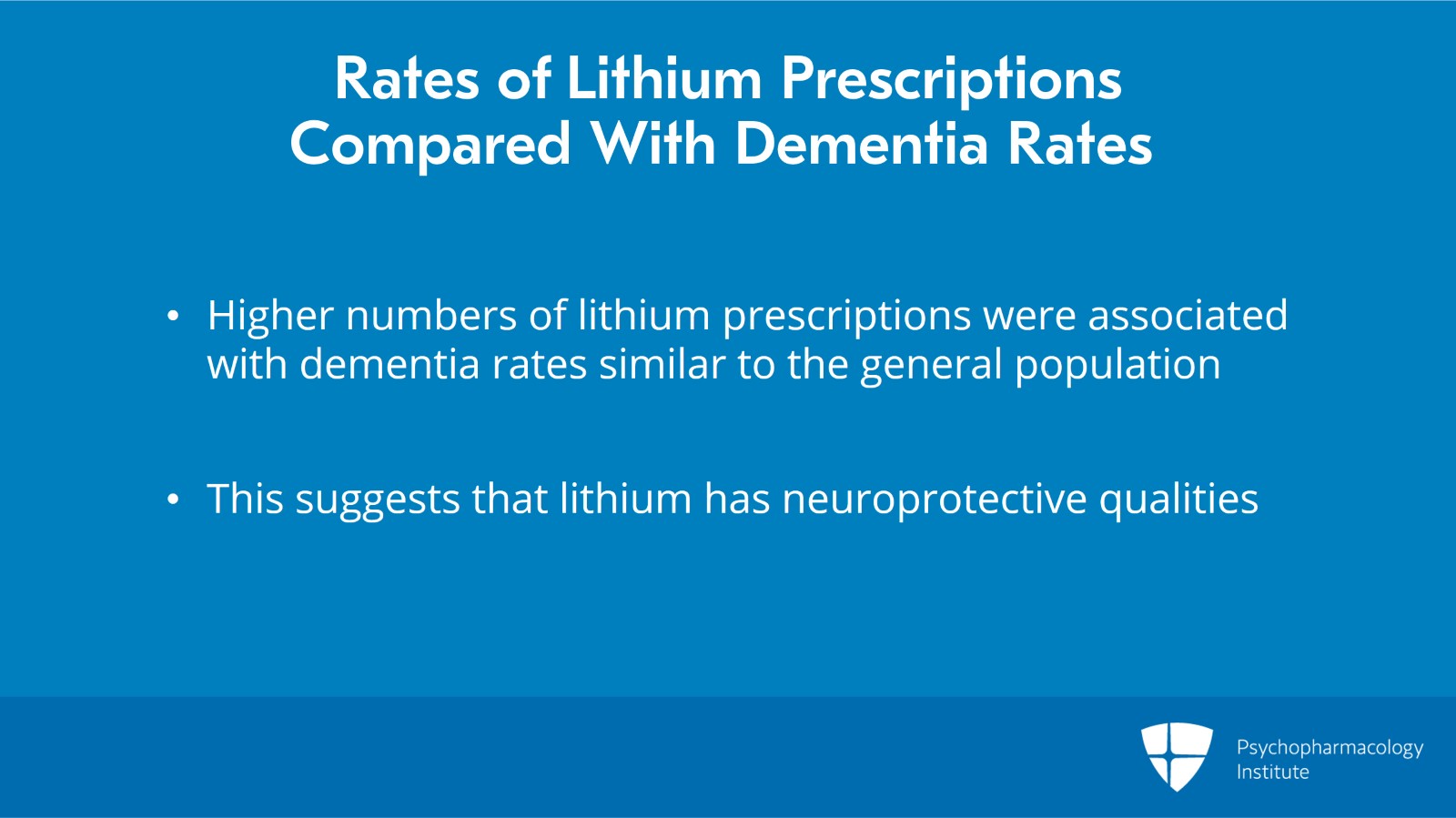
The potential neuroprotective qualities of lithium. So this is a slide from Lars Kessing and some colleagues looking at the rates of lithium prescription relevant to rates of dementia.
And what it really identified is that while people that were prescribed at least one lithium prescription had higher rates of dementia,
if we look at higher numbers of lithium prescriptions, we generally see that if they are prescribed lithium, stay on lithium, get a lot of prescriptions that their rates of dementia get closer and closer to the general populations, again suggesting that there may be some protection.
Slide 6 of 10
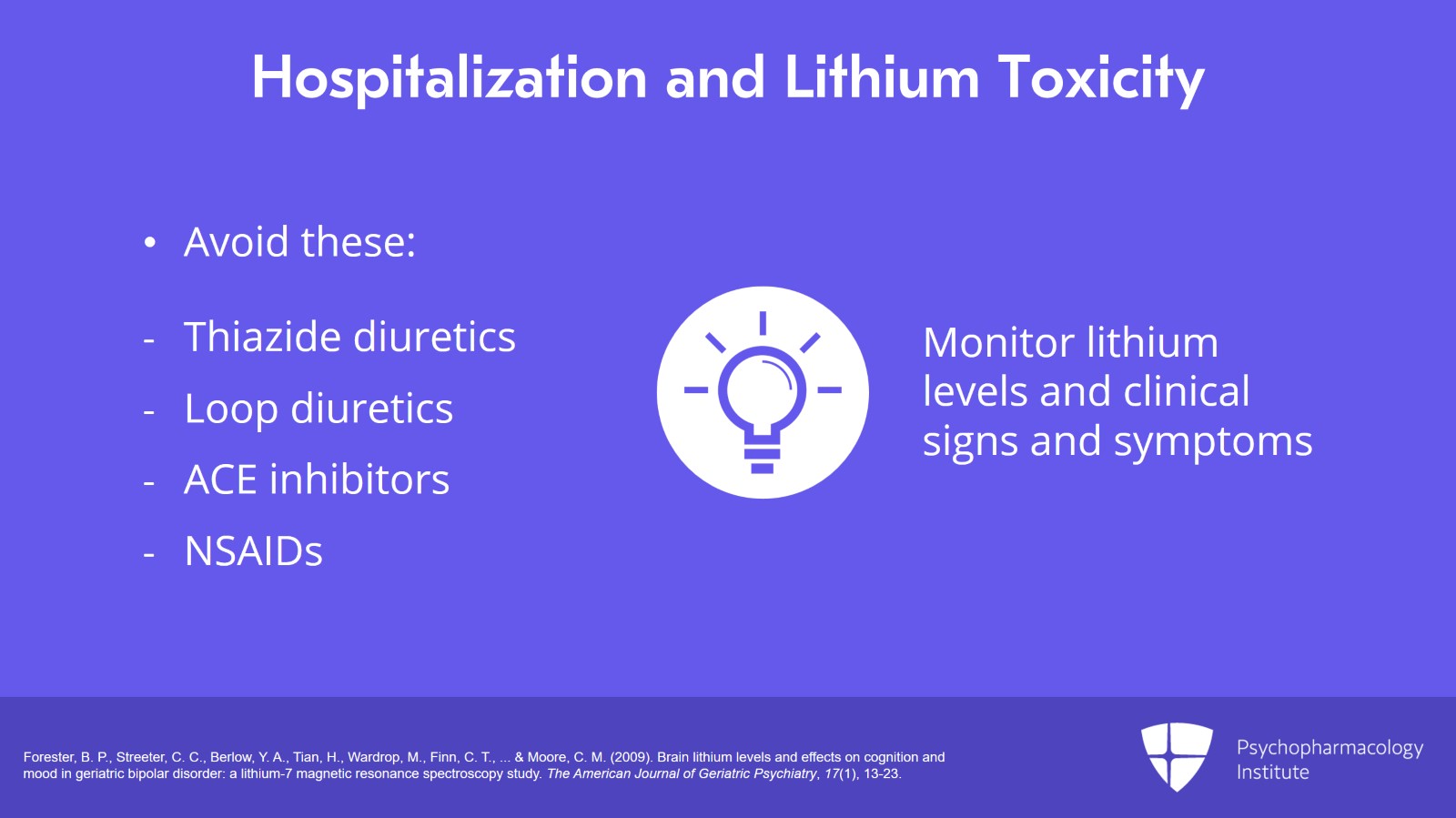
The next slide looks at hospitalizations for lithium toxicity and use of other medications that may increase lithium levels and/or reduce renal clearance.
So some of these offending drugs where we may see an increased relative risk would include things like thiazide diuretics, loop diuretics, ACE inhibitors and NSAIDs.
So that really underscores the importance of looking at comorbid medications. And if a patient is on something that’s going to make their kidney less effective at clearing lithium, then one may have to adjust either of those medications. But in particular, you’re going to want to look at serum lithium levels as well as clinical signs and symptoms.
References:
- Forester, B. P., Streeter, C. C., Berlow, Y. A., Tian, H., Wardrop, M., Finn, C. T., … & Moore, C. M. (2009). Brain lithium levels and effects on cognition and mood in geriatric bipolar disorder: a lithium-7 magnetic resonance spectroscopy study. The American Journal of Geriatric Psychiatry, 17(1), 13-23.
Free Files
Download PDF and other files
Success!
Check your inbox, we sent you all the materials there.
Slide 7 of 10
Now, before I finish this section, I want to just share with you I think some very, very interesting data from Brent Forester’s group that emphasized the point that blood levels are not everything.
So this group did a cross-sectional evaluation of 26 patients with bipolar disorder; 10 of them were over the age of 50. They looked at brain lithium spectroscopy and then found that serum and brain levels were correlated in the group as a whole.
So in younger people, serum levels or blood levels of lithium corresponded to what was going on in the brain and the brain levels.
But people that were over the age of 50 did not have that tight correlation, so kind of all bets are off. The predictability was less good. And in older patients, higher brain lithium was associated with frontal lobe dysfunction and higher depression ratings.
So the conclusion here is that the relationship between brain and serum lithium levels is not predictable in older people and it is the elevated brain lithium levels that appear to cause the toxicity.
References:
- Forester, B. P., Streeter, C. C., Berlow, Y. A., Tian, H., Wardrop, M., Finn, C. T., … & Moore, C. M. (2009). Brain lithium levels and effects on cognition and mood in geriatric bipolar disorder: a lithium-7 magnetic resonance spectroscopy study. The American Journal of Geriatric Psychiatry, 17(1), 13-23.
Slide 8 of 10
So the bottom line here is that you want to treat your patient, not your blood level. That’s not to say that blood levels are not important. They are. And I would recommend that you routinely get them. However, you want to continue to use your good clinical judgment and assess your patients for other signs of toxicity as well.
References:
- Forester, B. P., Streeter, C. C., Berlow, Y. A., Tian, H., Wardrop, M., Finn, C. T., … & Moore, C. M. (2009). Brain lithium levels and effects on cognition and mood in geriatric bipolar disorder: a lithium-7 magnetic resonance spectroscopy study. The American Journal of Geriatric Psychiatry, 17(1), 13-23.
Free Files
Download PDF and other files
Success!
Check your inbox, we sent you all the materials there.
Slide 9 of 10
So to wrap up this section, the key points are that while lithium can effectively treat mania and may have neuroprotective qualities, side effects can also occur especially in older people who have a greater medical burden.
Studies that have examined blood levels of lithium versus brain levels of lithium suggest that those two levels are not always correlated especially in older people.
That means that while it’s important to check serum or blood lithium levels it is also important for clinicians to use their clinical judgment and treat the patient, not the blood level.
Free Files
Download PDF and other files
Success!
Check your inbox, we sent you all the materials there.