



Slides and Transcript
Slide 1 of 9
Now, I’d like to talk about psychiatric disturbances in Parkinson’s disease over the course of the disease including the times when it is not clinically recognized or in the what we call prodromal period, before clinical diagnosis, because remember in the earlier video I described that the pathological process is probably going on for years, if not decades before the stage 3 process that affects the midbrain and causes the movement symptoms.
Slide 2 of 9
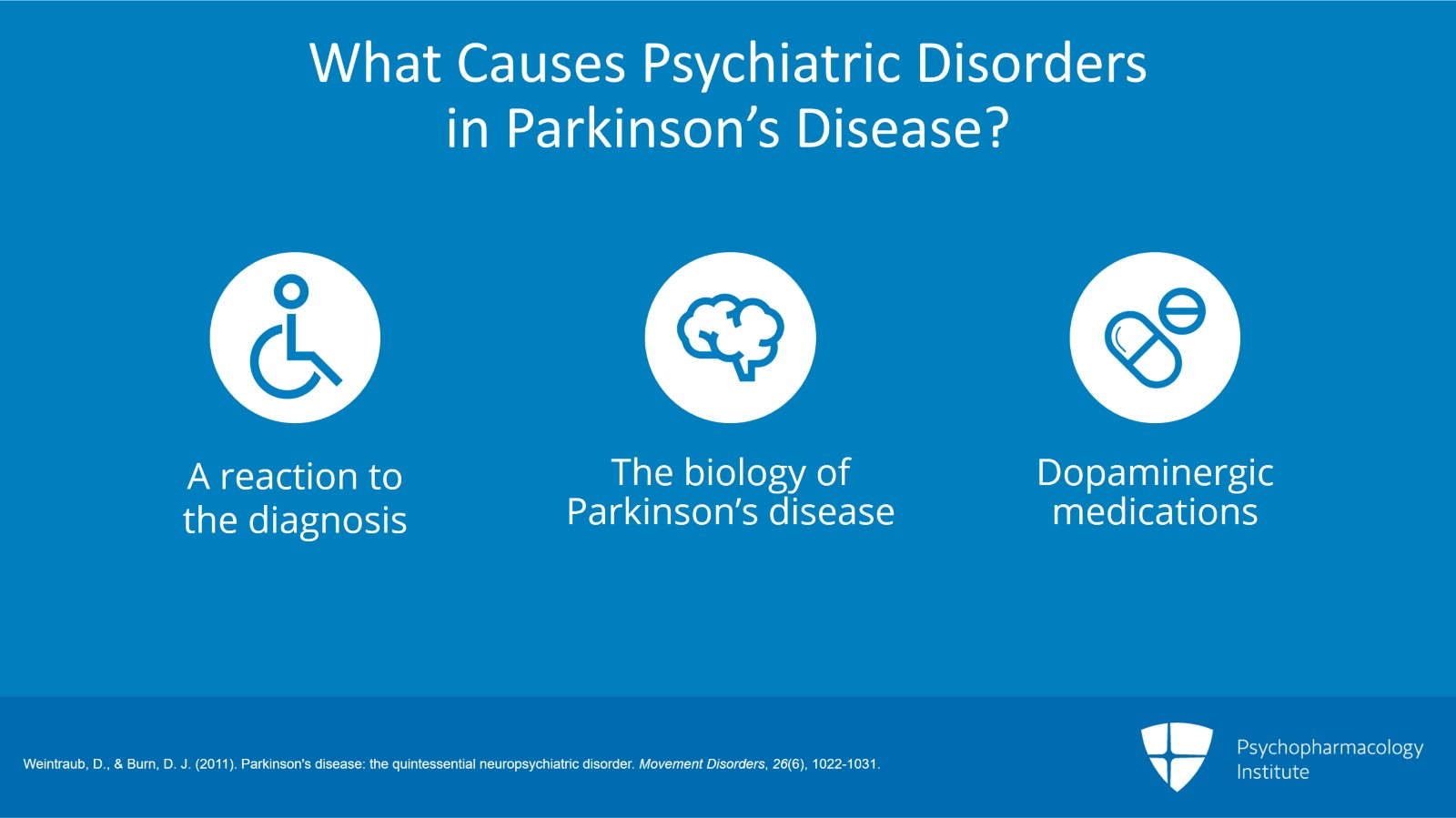
So the question would be then, what causes psychiatric disorders in Parkinson’s? Because almost all psychiatric disorders are overrepresented in Parkinson’s compared to the general population. There’s more depression, more anxiety, more psychosis. So one contributor is that it’s a reaction to the diagnosis. Having a sort of progressive chronic degenerative disease for which there is no cure alters your interpersonal roles, causes disability and has other psychosocial consequences. And so that almost certainly contributes to the increased prevalence of psychiatric disorders.
In addition, we think that there is an argument that the biology of Parkinson’s disease, you know, where the pathology occurs within the brain is actually a direct cause in some cases of the increased prevalence of the psychiatric disturbances. For instance, when you dysregulate the raphe nuclei which produce serotonin and the locus coeruleus which produces norepinephrine early in the disease, we know that these are two neurochemicals that are vital to the regulation of mood and anxiety in general, and because you lose these transmitters to a certain extent in the disease process, it might in part explain the increased prevalence of these disorders.
And finally, once the disease is recognized, once it’s been diagnosed clinically, you start administering these dopaminergic medications to treat the motor symptoms, the movement symptoms of the disease. So ideally, we would like to target the dopamine treatments to the nigrostriatal pathway but you’re taking these medications orally so they’re flooding the brain and going to the mesolimbic and tuberoinfundibular tracts and overloading those non-deficient areas with dopamine. And so it’s possible that the consequence of this excess exogenous dopamine in the wrong places is part of what contributes to psychiatric disturbances.
References:
- Weintraub, D., & Burn, D. J. (2011). Parkinson's disease: the quintessential neuropsychiatric disorder. Movement Disorders, 26(6), 1022-1031.
Unlock this Video Lecture and earn 1.0 CMEs
Become a Bronze, Silver, Gold, Bronze extended, Silver extended or Gold extended Member.
Already have an account? Sign in
